

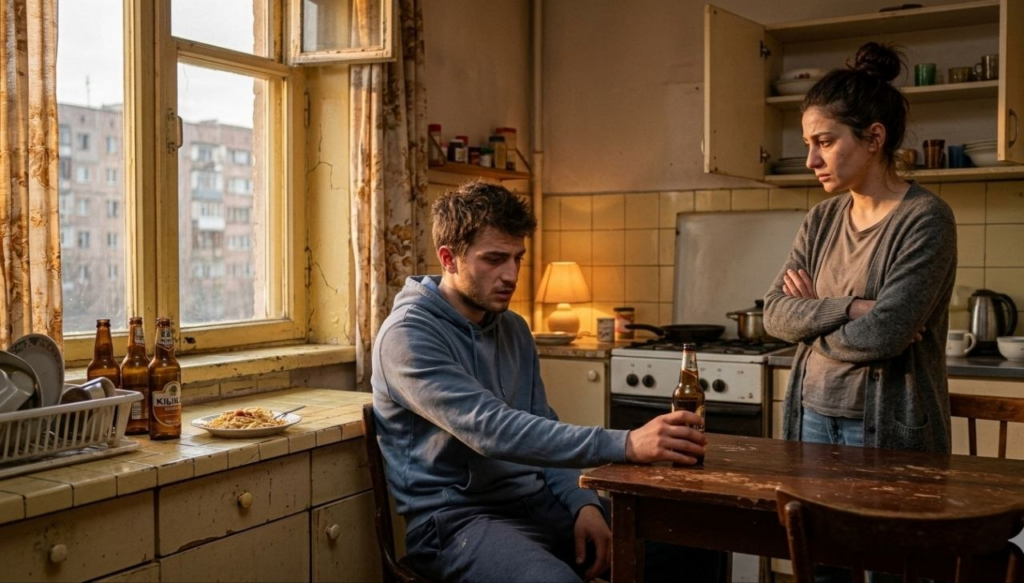
The kitchen smelled faintly of stale beer and burnt toast. Sunlight streamed weakly through the grimy window, casting a dull glow across the chipped countertops and the half-empty bottle on the table. Marsha stood near the doorway, arms crossed, a deep crease forming between her brows as she watched her husband slouch in his chair. Tom’s hair was unkempt, his shirt wrinkled, and the faint odor of alcohol clung to him like a second skin.
“Tom,” she said, her voice measured but edged with exhaustion, “when are you going to find a job? We can’t keep living like this.”
He grunted, avoiding her gaze, and took another swig from the nearly empty bottle. “I’ll figure it out,” he muttered, though the words sounded hollow even to him.
Marsha let out a long sigh, her shoulders sagging. She had begged, pleaded, and argued, but nothing seemed to make a difference. Each day, Tom sank deeper into his bottles, while the weight of unpaid bills and looming responsibilities pressed down on them both. She knew she couldn’t force him to care, but she hoped, against reason, that he might wake up before it was too late.
The house had once been a place of warmth and laughter. The walls had echoed with Tom’s laughter, the smell of Marsha’s cooking, and the chatter of neighbors. Now, it felt suffocating, silent except for the occasional clink of glass and the soft hum of the refrigerator. The air smelled of old alcohol and missed opportunities. Marsha’s eyes followed him as he drained the bottle again, her lips pressed tightly together to keep from shouting.
“Tom, we need to talk,” she said, softer this time, almost pleading. “I can’t do this alone. I can’t carry everything.”
He waved a hand dismissively, eyes glazed. “You don’t understand. I’m doing my best.”
“No, you’re not,” she said firmly, her voice breaking slightly. “Doing your best doesn’t mean drinking yourself into oblivion every night. We need money, we need food, we need—”
“Enough!” he snapped, slamming the empty bottle on the table. Marsha flinched at the sharp sound, and the silence that followed was heavier than before. He rubbed his temples, his anger fading into a dull resignation. “I said I’ll figure it out. Why can’t you just… leave me alone?”
Marsha shook her head, stepping back. “Because I love you, and I can’t just watch you throw your life away. I can’t keep pretending everything is fine when it’s not.”
For a moment, the two of them stood there in silence, the weight of unspoken words pressing down on the room. The sunlight outside dimmed slightly as clouds drifted past the window, casting a gray pallor over the kitchen. Marsha turned away, her hands gripping the edge of the counter. She knew words alone wouldn’t reach him, but she couldn’t stop trying.
Later that afternoon, Tom left the apartment, bottle in hand, and wandered aimlessly down the streets near their neighborhood. The city was busy, people moving in a blur of hurried steps, shouting, and the distant rumble of traffic. Tom’s mind was elsewhere, clouded by alcohol and frustration. He stumbled slightly, muttering curses under his breath, unaware of how careless he had become.
He didn’t notice the small details—the uneven pavement, the construction cones along the sidewalk, or the distracted pedestrians weaving around him. The world seemed to move faster than he could keep up with, a blur of motion and sound he barely registered.
Suddenly, a loud screech of brakes tore through the air. Tom froze. A delivery truck, traveling too fast for the narrow street, swerved sharply to avoid him. His heart jumped into his throat, and he stumbled backward onto the curb, knees weak and hands shaking. The bottle slipped from his fingers and shattered against the pavement, spraying shards of glass across the sidewalk.
A chorus of gasps rose from the nearby pedestrians, some shouting warnings, others simply frozen in shock. Tom’s face went pale, the realization of how close he had come to death hitting him with full force.
He had been so careless, so wrapped up in his own frustrations and drunken haze, that he hadn’t even noticed the danger until it was nearly too late.
An elderly man who had witnessed the scene walked over, shaking his head. “Son, you need to take care of yourself,” he said, his voice firm yet calm. “Life doesn’t wait for anyone, and it doesn’t forgive foolishness.”
Tom’s hands trembled as he looked down at the broken glass at his feet. Shame and fear mingled with a strange clarity that began to pierce through the fog of alcohol. Marsha’s words from that morning echoed in his mind: “When are you going to find a job?”
It wasn’t just about finding work. It was about responsibility, about caring for the people who depended on him, about finally stepping out of the haze that had consumed him for months. The near-death experience on the street had shaken him in a way that no argument could.
He stumbled back toward his apartment, each step heavy but purposeful. He replayed the events in his mind, seeing the danger he had narrowly escaped, feeling the rush of panic that had gripped him. For the first time in a long while, he felt the fragile edge of life, the sharp reminder that he was not invincible.
By the time he reached the apartment, Marsha was waiting by the door, arms crossed, but her face held a mixture of worry and hope. Tom set down the empty bottle, its shards glinting faintly in the fading sunlight, and met her gaze. For a moment, neither of them spoke, the weight of unspoken words filling the small space.
“I’ll start tomorrow,” he said finally, voice low but steady. “I’ll find a job… and I’ll make this right.”
Marsha’s lips curved into a faint smile, relief flickering in her eyes. “That’s all I’ve ever wanted, Tom,” she said softly. “Just… try. For us.”
Tom nodded, swallowing hard, feeling a strange sense of purpose rising within him. He knew it wouldn’t be easy, that habits and mistakes would not disappear overnight. But for the first time, he felt a spark of determination, a willingness to step out of the haze and face the world with intention.
The evening settled into the apartment like a blanket, quiet but filled with possibility. Outside, the streets continued their relentless motion, oblivious to the small transformations occurring within a single apartment. Tom and Marsha sat together at the kitchen table, the broken bottle discarded, the conversation flowing in soft, cautious tones.
Days passed, and Tom followed through on his promise. He applied for jobs, cleaned the apartment, and began taking small steps toward rebuilding a life that had been fractured by alcohol and neglect. Each day was a struggle, each decision a test of his newfound resolve, but he persisted.
Marsha watched him, cautiously optimistic, offering support when needed but allowing him to take responsibility for his actions. She saw the change in him not as sudden, miraculous, or complete, but as gradual, real, and hard-earned.
One evening, Tom returned from an interview with a slight grin on his face. “I think I have a chance,” he said, holding up a letter of consideration from a local company. His hands were steady, his eyes clear, and for the first time in months, Marsha felt the weight of hopelessness lift from her shoulders.
They celebrated quietly that night, sharing a simple meal and sitting close together at the small kitchen table. The world outside remained chaotic, unpredictable, and often unforgiving, but inside the apartment, a fragile sense of hope had taken root.
Tom had learned, painfully and vividly, the value of responsibility, the consequences of neglect, and the importance of cherishing life before it slipped away. The near-accident on the street had been a terrifying wake-up call, one he would never forget. And in that realization, he found the strength to rebuild, to face his shortcomings, and to embrace the life he had been given.
Months later, the apartment no longer smelled of stale beer. The counters were clean, the windows washed, and the small bottle of alcohol that had once dominated their lives was gone entirely. Tom had secured a job, working hard each day, and though it was not glamorous or easy, it provided stability and a renewed sense of purpose.
Marsha looked at him one morning, a quiet pride in her eyes. “You’ve changed,” she said softly, though not as praise, more as recognition. “I see it in the way you move, the way you think, the way you care.”
Tom smiled, a real smile this time, not the hollow grin of a man trying to convince himself of competence. “I’m learning,” he admitted. “It’s not perfect, but I’m trying. That’s all I can do.”
And in that small, quiet apartment, surrounded by the ordinary chaos of life, they found a fragile peace—a peace born from fear, mistakes, and the terrifying lesson that life could be lost in an instant if it was taken for granted.
Tom would always remember the screech of brakes, the shards of glass on the pavement, and the pounding of his heart as he narrowly avoided death. But more than that, he would remember the lesson it brought: that life is fleeting, fragile, and beautiful, and that sometimes the only way to survive it—and to truly live—is to take responsibility for one’s actions, to care for those around you, and to embrace the chance for change, no matter how small.
From that day forward, he walked a little taller, worked a little harder, and loved a little deeper, understanding finally that the edge of danger and the edge of redemption were often separated by a single moment, and that life could change in an instant.
