

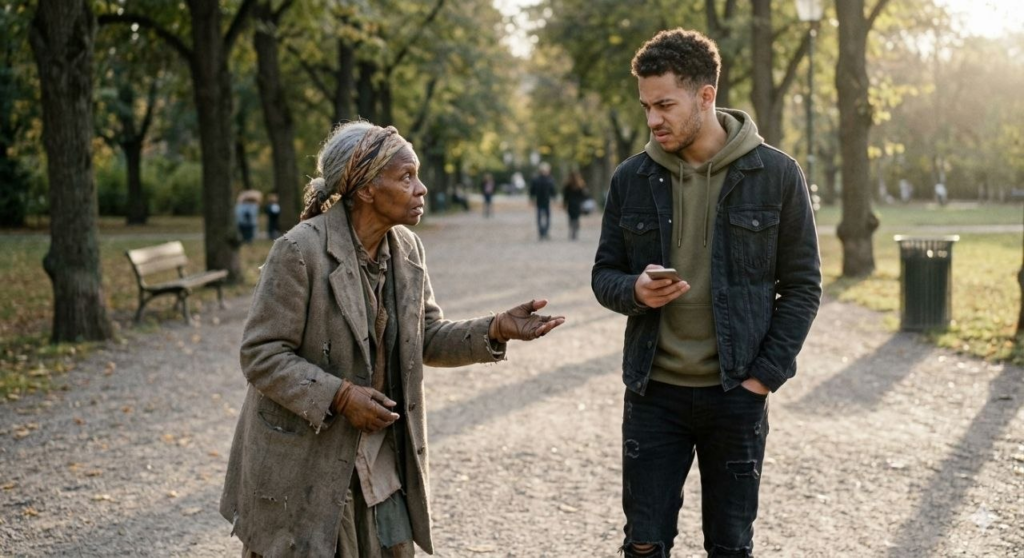
The park was unusually quiet that afternoon, as if the world itself was holding its breath. Bare branches stretched like skeletal fingers across the pale sky, casting long shadows on the cracked pavement below. Patches of dried leaves rustled in the faint breeze, the only sound interrupting the oppressive silence. At the edge of the park, an old woman shuffled along the path, her movements slow and unsteady. Her gray hair hung in thin, wispy strands around her lined face, and her clothes, once perhaps elegant, were now tattered and threadbare. Her shoes were worn, soles nearly detached, and the thin fingers of her hands trembled as she clutched a small, empty bag.
She paused by a park bench, taking a shaky breath, her lungs protesting with every inhalation. Her eyes, pale and milky with age, scanned the surroundings for anyone who might offer help. Most of the few people around avoided her, turning their faces away as if seeing her was an inconvenience or a reminder of discomfort they didn’t want to face.
At the far end of the path, leaning casually against a lamppost, was a young man about twenty years old. He wore expensive sneakers, tight jeans, and a jacket that looked freshly pressed. His hair was perfectly styled, his phone glued to his hand, and the air around him radiated arrogance. He laughed quietly at something on his screen, completely unaware of the world beyond his bubble of comfort.
The old woman summoned what little strength she had left and approached him, shuffling forward with small, deliberate steps. Her voice was a soft rasp, but carried enough clarity to reach him. “Please… just a little something to eat,” she said, holding out her empty bag like a silent plea.
The young man glanced up, eyes narrowing in annoyance. He took in her frail figure, the torn clothes, the trembling hands, and a smirk played across his lips. “Go away,” he said dismissively, his tone sharp and cutting. “I don’t have anything for you.”
The old woman’s gaze hardened, and a strange intensity flared in her pale eyes. “You will regret this,” she said softly, almost like a whisper carried on the wind, but there was a weight to her words that made him instinctively shiver.
He laughed, the sound harsh and loud in the quiet park. “Regret? Me? Don’t make me laugh. Now scram, old lady,” he sneered, brushing past her and returning to his phone, his mind convinced that he was untouchable, that nothing in the world could affect him.
The woman stood silently for a moment, leaning on her cane, her eyes never leaving him. There was a quiet dignity in her posture, a defiance that belied her frailty. Then she turned slowly, shuffling down the path, her bag empty, her steps measured and deliberate. She disappeared behind the trees, leaving a strange, lingering unease in the air.
The young man smirked to himself and continued scrolling through his phone, confident that life had nothing to teach him today. The sun hung low in the sky, casting long, golden streaks across the park, yet the boy felt no warmth.
Hours passed. The park slowly emptied as the day faded into twilight. Shadows grew long and stretched across the pathways, twisting and merging with the darkness that crept in between the trees. The young man, now walking toward the street to head home, began to feel a subtle unease he couldn’t explain. It was as if the air itself had thickened, pressing against his chest. He shook his head, blaming the eerie silence for his rising anxiety.
He didn’t notice the subtle changes at first—the leaves rustling with a strange cadence, the shadows seeming to shift and breathe, or the faint outline of the old woman appearing again at the far edge of the park, watching silently from the darkened pathway.
As he walked, his phone buzzed insistently in his pocket. He pulled it out, expecting a message from a friend or a notification about some trivial event. But the screen was blank. A chill ran down his spine. He shook the phone, turned it off, and then back on, but nothing appeared.
The laughter and music that had filled his earbuds were gone, replaced by the oppressive quiet of the park.
He quickened his pace. The familiar streets were ahead, lights beginning to flicker on in apartment windows and shopfronts, yet the sense of unease did not leave him. He glanced behind, half expecting someone to be following, but saw nothing—only the fading shadows stretching along the cracked pavement.
Then, without warning, a sudden crash rang out. A pile of construction scaffolding from a nearby site wobbled dangerously, sending a cloud of dust into the cool evening air. The young man froze. He had almost stepped directly beneath a metal beam that now hung precariously, trembling as though the slightest touch could send it crashing down.
Heart hammering, he stumbled backward, his mind finally registering the danger. His usual arrogance gave way to panic. “Watch out!” he shouted instinctively, realizing for the first time that life could be fragile, fleeting, and terrifying.
From the shadows, the old woman emerged again, her movements slow but purposeful. She held her cane in one hand, leaning heavily on it, yet there was a strength in her stance, a clarity of purpose. She gestured toward him, pointing at the beam, her voice cutting through the chaos. “Move!”
The young man’s legs shook. Fear had rendered him immobile, but the woman’s words jolted him into action. He stumbled forward, narrowly avoiding the falling metal. Sparks and debris scattered around him as the beam clanged violently against the ground, inches from where he had been standing moments ago.
He turned to see the old woman, pale and trembling from the exertion, but her eyes were unwavering, filled with a fierce intensity that seemed almost otherworldly. “Do you see now?” she asked, her voice low but sharp. “Do you see what it means to disregard life?”
He swallowed hard, words failing him. His usual confidence, his sense of invincibility, had been shattered in an instant. The weight of his arrogance pressed down on him like the beam itself, heavy and inescapable.
The woman straightened slightly, leaning on her cane, and studied him. “Arrogance makes you blind,” she said. “Blind to the world, blind to those around you. You will remember this night.”
The young man nodded, his face pale, realizing that she was right. He had been careless, selfish, and dismissive, thinking the world owed him everything. Now, staring at the destruction and at the woman who had somehow guided him to safety, he felt a strange mixture of shame, gratitude, and awe.
“Why… why are you helping me?” he asked, his voice barely above a whisper.
The old woman’s lips curved into the faintest smile, and her eyes, though tired and lined with age, glimmered with a wisdom that only comes from decades of surviving the world. “Because sometimes the smallest actions, the quietest warnings, are the ones that can save a life,” she said.
The young man watched as she slowly turned and walked back toward the park’s edge, disappearing into the shadows like a figure from a dream. He remained frozen for several moments, heart racing, sweat clinging to his brow. The night had grown colder, and the streetlights flickered dimly, but he felt as though something inside him had been permanently altered.
He finally exhaled and took a cautious step forward, looking back at the fallen scaffolding and the empty path where the old woman had been. Her warning had been clear, and the lesson was seared into his memory. Arrogance and indifference could have cost him his life.
From that day forward, he found himself noticing things he had ignored before—the old man struggling with groceries, the mother chasing after her child, the stray animals seeking food in alleyways. The small details of life, which he had once dismissed as unimportant, now held meaning.
The old woman had disappeared from his sight, but her presence lingered in his mind. Her warning, delivered in the park that afternoon, had awakened something in him he didn’t know existed—a recognition of fragility, a respect for life, and a humility that could not be taught through words alone.
Even as he left the park that night, the street quiet again, the young man felt the echo of her words follow him. “You will regret this,” she had said. And indeed, he would—though not in the way she had intended. He would regret the arrogance and the indifference he had carried before, and he would remember the old woman as the one who had forced him to truly see the world for what it was—fragile, beautiful, and unpredictable.
As he walked toward home, the city lights glowing softly in the distance, he made a silent promise to himself. Never again would he take life for granted, never again would he assume that his comfort and security made him invincible. And somewhere, in the shadows of the park, the old woman watched silently, her warning fulfilled in the most profound way possible.
