

Chapter 1: The Room Behind the Door
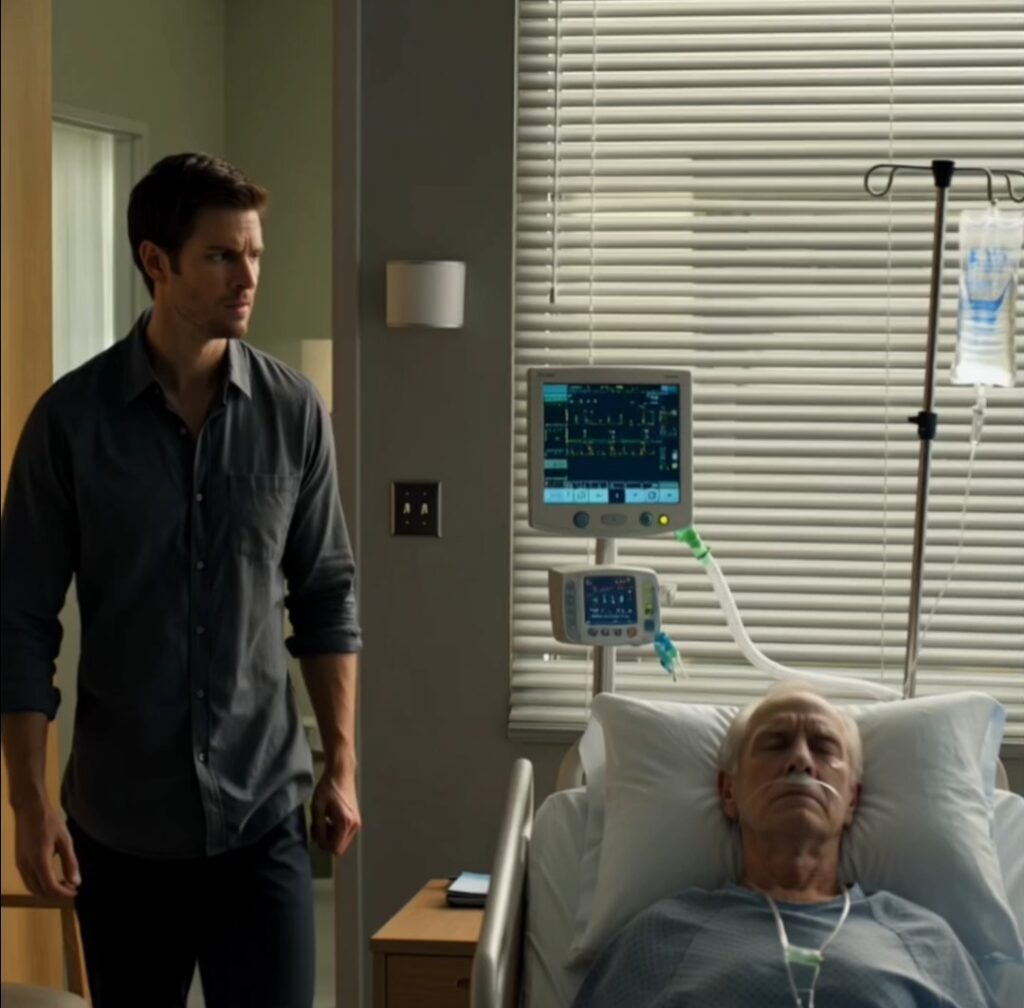
The room was quiet in the way only hospital rooms can be—so still it made your heartbeat sound loud.
At first, I thought I had walked into the wrong place.
There was no hidden lover. No secret child. No proof that Anna had lied to me in some cruel, unforgivable way.
There was only a man in a bed.
He looked frail, almost folded into the white sheets. Oxygen tubes rested beneath his nose. His skin was pale, his hands thin, but his eyes—his eyes opened the second I stepped in, and they locked onto mine as if he had been waiting years for that exact moment.
“Logan?” he whispered.
I froze.
I had never seen him before in my life.
“Yes,” I said slowly. “Who are you?”
His lips trembled. Tears gathered in the corners of his eyes before he even answered.
“I’m your father.”
The words hit me like something physical, like the room itself had shifted.
I stared at him, trying to make sense of the sentence, trying to fit it into a life that had never once made room for a father. I had grown up in an orphanage. No birthday cards. No letters. No one coming back with an explanation.
Nothing.
I took a step backward.
“No,” I said. “No, that’s not possible.”
He shut his eyes, as though my disbelief was pain he had rehearsed for and still could not bear.
From the corner of the room came a soft sound. I turned.
The elderly woman with the bouquet sat near the window, watching us with a sorrowful tenderness. She was no stranger to this room. No stranger to him.
“She’s my mother,” the man said weakly. “Your grandmother.”
I looked from one to the other, my breath going shallow.
Anna knew.
That truth arrived before anything else.
Anna knew.
Chapter 2: The Secret Anna Carried
My hands curled into fists.
“Why would Anna keep this from me?” I asked. “Why would she bring me here on our wedding day instead of telling me the truth?”
The old woman rose slowly and came closer.
“Because he begged her not to tell you until today,” she said. “He wasn’t sure he would live long enough to see this day. But he wanted one thing before he died. He wanted to see you married. He wanted to ask forgiveness while he still could.”
I looked at the man in the bed—the stranger who was somehow my father.
He swallowed hard.
“When you were three,” he said, voice raw, “your mother died. We had nothing. I was drowning in debt, grief, and drink. I told myself I’d come back for you after I got my life together. But shame grows teeth. The longer I stayed away, the harder it became to return. Eventually, I believed you’d be better off never knowing me than knowing the truth of what I’d done.”
My chest burned.
“Better off?” I repeated. “I grew up believing no one wanted me.”
His face crumpled.
“I know.”
Those two words landed with more weight than any excuse could have.
Not a defense. Not a lie. Just the plain, ugly cost of a cowardly choice.
“I searched for you later,” he continued. “When I got sober. When I finally became the man I should have been. But the orphanage records were incomplete. Years passed. Then Anna started volunteering here with the hospital outreach team, and my mother heard her talk about you. About Logan. About the orphanage. About the way you both met as children and found each other again as adults. We realized who you were.”
I turned sharply to my grandmother. “So you used Anna to get to me?”
She shook her head at once.
“No. We told her the truth, and she refused to lie to you forever. She only agreed to wait because this man…” she glanced at her son with both love and disappointment, “…is dying. And because she believed some truths must be told face-to-face, not through fear.”
I felt anger rising hot and fast.
At him.
At Anna.
At the cruel timing of all of it.
A wedding day should begin with clarity, not confusion. It should not drag old ghosts into the light right before vows.
And yet somewhere beneath the anger was something harder to admit:
a hunger I had buried years ago.
To know.
To be known.
To understand why I had been left.
Chapter 3: The Bride in the Hallway
When I stepped back into the corridor, Anna was waiting for me.
Still in her wedding dress. Still holding herself with that quiet steadiness I had always loved.
But her eyes were wet.
“I was coming to find you,” she said.
“You knew,” I answered.
She nodded. “Yes.”
I laughed once, bitterly. “That seems like something a man should know before he agrees to get married in a critical care ward.”
“You’re right,” she said softly.
Her honesty disarmed me more than excuses would have.
“I wanted to tell you a dozen times. I almost did. But every time, I saw how deeply abandonment still lived inside you. I didn’t want you hearing it in a way that felt like another wound. He asked for one chance—not to erase the past, but to face it. I thought… maybe today, of all days, should be about truth. Real truth. The kind a marriage can actually stand on.”
I looked away, jaw tight.
“You should have trusted me with the choice.”
“I know,” she whispered. “And if you walk away from me for that, I will deserve it.”
That was Anna. No performance. No manipulation. Just a trembling heart standing in the open.
For a long moment, neither of us spoke. Around us, machines beeped in nearby rooms. Nurses moved gently past. Families waited on plastic chairs, suspended between hope and grief.
And suddenly the hospital made terrible, perfect sense.
Not because it was romantic.
Because it was real.
What better place to begin a marriage than where illusions fall away? Where pride looks smaller. Where life itself reminds you that love is not about staging pretty moments, but about showing up when things are fragile, unfinished, and hard.
Epilogue: Where Vows Mean Something
I went back into Room 214.
My father looked at me as if he expected a sentence.
I did not tell him everything was fine.
It wasn’t.
I did not pretend the lost years could be restored by one revelation.
They couldn’t.
But I also understood that bitterness is a tempting inheritance. It feels strong at first, almost righteous. Yet in the end, it asks you to carry the very pain you wish had never touched you.
“I can’t give you back all at once what was broken,” I said.
He nodded through tears.
“But I won’t let your failure decide the kind of man I become.”
He started crying openly then, shoulders shaking against the sheets.
My grandmother covered her mouth.
A few minutes later, the officiant arrived. So did Anna. A nurse moved quietly to the doorway. Then another patient’s family gathered in the hall, drawn by the sight of a bride in white standing beneath fluorescent lights.
We got married there, between the scent of antiseptic and lilies, between sorrow and mercy, between what had been stolen and what could still be redeemed.
When Anna took my hands, her voice shook.
When I said my vows, I understood them more deeply than I ever would have in a ballroom.
Home, I realized, is not built from perfect beginnings.
It is built when two people choose truth over image, mercy over pride, and love over fear.
And in that hospital, surrounded by the brokenness people usually try to hide, I finally saw what Anna had wanted me to understand all along:
A marriage strong enough for life must be honest enough for pain.
That day, I did not just gain a wife.
I laid down one more piece of the orphan inside me.
And for the first time, the word family stopped sounding like something that belonged to other people.
