

Storms. Recessions. Ownership changes. Even the highway reroute that nearly destroyed every business on the block.
But every morning at six, the lights still came on.
Coffee still brewed.
And Margaret Hale still worked the front counter.
She was seventy-three years old, small, silver-haired, and moved slower than she once did. But she remembered every regular by name and every order before customers even sat down.
That morning began quietly.
Rain tapped against the windows. Plates clinked softly. Old country music played from a speaker near the kitchen.
Then the black SUVs arrived.
Three of them.
Clean. Government plates.
The diner grew quieter as several men stepped inside wearing dark jackets with military insignias stitched near their shoulders.
At the center walked Colonel Richard Vance.
Decorated officer. Television interviews. National hero headlines.
The kind of man people recognized immediately.
The owner rushed forward nervously.
“Colonel Vance, welcome—”
Vance barely acknowledged him.
He removed his gloves slowly and sat at the largest booth without asking. The men around him followed.
Margaret approached carefully with a coffee pot in hand.
“Morning, gentlemen,” she said kindly. “Can I start you with—”
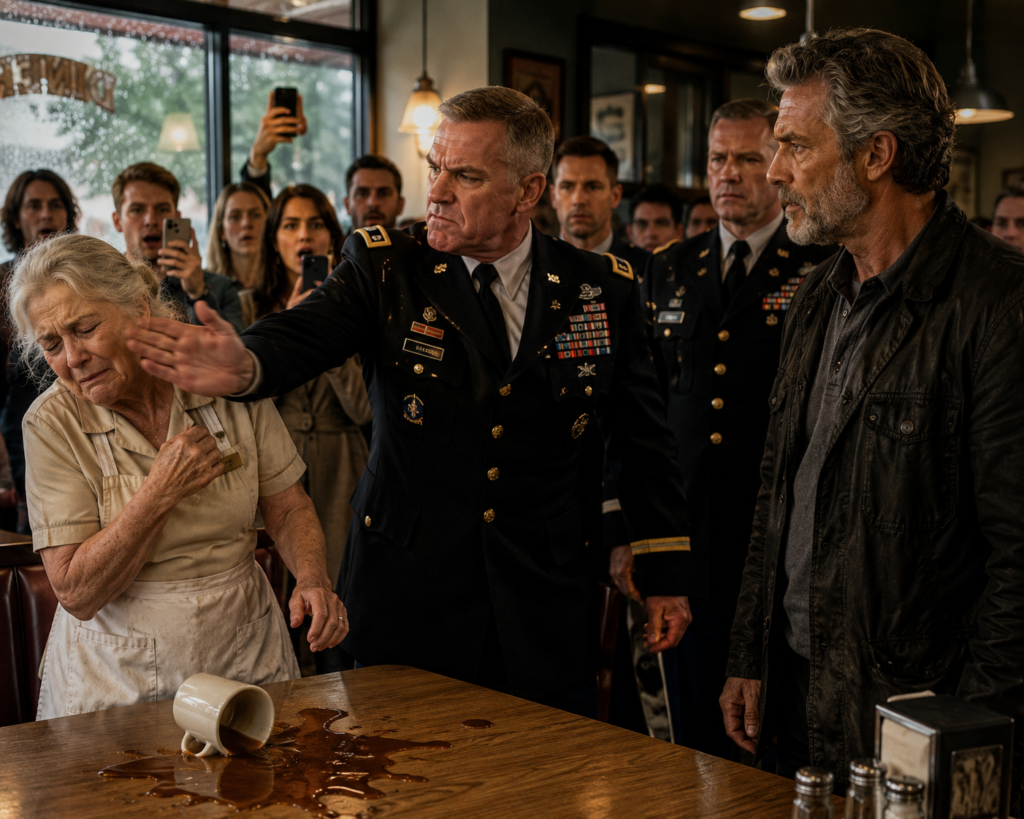
Her hand slipped.
Just slightly.
One cup tipped.
Coffee splashed across the table and onto Vance’s sleeve.
Silence hit instantly.
Margaret gasped softly.
“Oh goodness, I’m so sorry—”
The slap came before she could finish.
The crack echoed through the diner.
Margaret stumbled sideways into the booth divider, one hand against her cheek.
Nobody moved.
Nobody even breathed at first.
Phones slowly began rising.
Someone whispered, “Oh my God…”
Colonel Vance stood calmly, wiping coffee from his sleeve as if nothing important had happened.
“You people survive because men like me allow it,” he said coldly. “Maybe this place needs inspection.”
The owner turned pale immediately.
“Colonel, please—she didn’t mean—”
“I know exactly what she meant,” Vance interrupted.
Margaret tried to steady herself, still apologizing, still trying to protect the diner.
“I’m alright,” she whispered weakly.
But the room had changed.
The air felt heavy now. Dangerous.
Then a chair scraped loudly against the floor.
Every head turned.
A man stood from the corner booth near the window.
Tall. Broad shoulders. Gray beard. Plain dark jacket.
Nobody had really noticed him before.
But now everyone did.
He walked forward slowly.
Not rushed.
Not emotional.
Controlled.
The kind of control that usually meant something worse was coming.
Vance noticed him immediately.
“You have something to say?” the colonel asked.
The man stopped beside Margaret first.
Carefully helped her steady herself.
Only then did he look at Vance.
“Yes,” he said calmly.
His voice was quiet, but somehow it carried through the entire diner.
“You just made the biggest mistake of your career.”
Several of Vance’s men shifted instantly.
The colonel smirked faintly.
“Do you know who you’re talking to?”
The stranger nodded once.
“Better than you know who you hit.”
That landed differently.
Phones lifted higher.
Margaret looked up at the man beside her, confused now.
Vance crossed his arms.
“Alright then,” he said mockingly. “Who is she?”
The man looked at Margaret for a moment.
Not with pity.
With respect.
Then he answered.
“She’s the woman who hid military families in this diner during the Black Ridge evacuation.”
Silence spread across the room.
Vance’s expression tightened slightly.
The stranger continued.
“When federal transport routes failed, when armed groups were targeting evacuation convoys, this woman kept forty-two civilians alive in her basement for nine days.”
The diner remained frozen.
Even the kitchen stopped moving.
Vance laughed once.
Short. Disbelieving.
“And you expect me to believe that?”
The man reached into his jacket slowly and pulled out a badge.
Federal Special Investigations Division.
Several of Vance’s men immediately straightened.
The colonel’s smirk disappeared.
The investigator held the badge up briefly before putting it away.
“We’ve been investigating missing wartime supply routes for fourteen months,” he said calmly. “Your name came up often.”
Now nobody was recording for entertainment anymore.
They were recording history.
Vance’s jaw tightened.
“You think you can threaten me?”
“No,” the investigator replied calmly.
“I think you threatened yourself the moment you touched her.”
Margaret stared at him in disbelief.
“…Daniel?” she whispered softly.
The investigator finally smiled slightly.
“You still remember me.”
The entire diner turned toward her.
Daniel looked around slowly before speaking again.
“I was twelve years old when she hid us under this building.”
His voice remained calm, but emotion now lived underneath it.
“My mother was wounded. My little sister had pneumonia. We would’ve died there.”
Margaret’s eyes filled instantly.
“You were the little boy with the red jacket…”
Daniel nodded slowly.
“And she fed us from almost nothing,” he said.
Complete silence.
Vance looked between them, uncertain now for the first time.
Daniel stepped closer.
Not aggressive.
Certain.
“You hit a woman the government quietly honored fifteen years ago.”
He paused.
“And you did it on camera.”
One of Vance’s officers quietly lowered his eyes.
Because now this wasn’t about spilled coffee anymore.
It wasn’t even about the slap.
It was about a decorated officer realizing too late that the woman he humiliated in public wasn’t powerless.
And neither were the people who remembered what she had done.
