

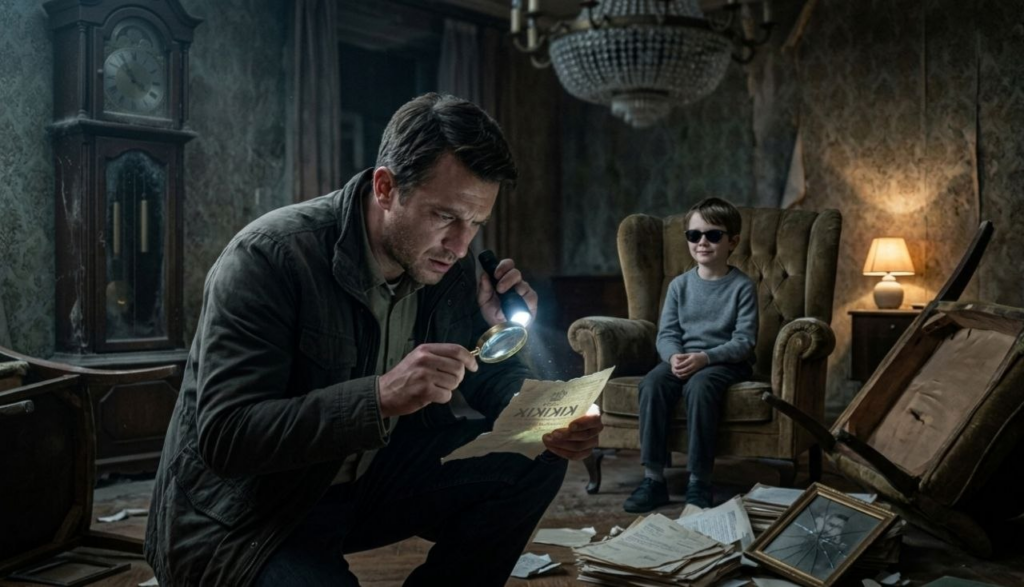
Detective Smith had been at the scene for hours, pacing the long hallways of the old Victorian house that had become the epicenter of confusion and fear. Broken glass littered the floor, and furniture was overturned, as if a storm had ripped through the living room, leaving only chaos in its wake. Yet no one could explain why, or what had started it. Smith had examined every corner, every crack in the walls, every faint fingerprint, and nothing made sense. Every clue seemed to contradict another, and each logical explanation crumbled under closer inspection.
He leaned over the coffee table, rubbing his temples. “This doesn’t add up… none of it does,” he muttered to himself. The house seemed to hum with a quiet, oppressive tension, like it knew secrets it would never share. He had interviewed neighbors, family members, and the few people who had witnessed the events, but their accounts were fragmented, contradictory, and often nonsensical.
The chaos outside—the sirens, the curious neighbors, the reporters—felt distant, almost unreal. Inside, the detective felt trapped in a bubble of unanswered questions and mounting frustration. He had solved hundreds of cases in his career, but this one eluded him entirely. Something about the pattern—or lack of pattern—was gnawing at him.
From the corner of the room, a soft, clear voice broke the heavy silence.
“Detective Smith.”
He froze mid-step, startled. Turning toward the voice, he saw a small boy sitting quietly in a chair against the far wall. The boy looked no older than eight or nine, dressed simply, with dark sunglasses covering his eyes. Smith remembered the boy being brought in by a neighbor during the commotion. Blind, they had said. Yet there was something unsettling in the way the boy sat, calm and deliberate, exuding an awareness that belied his years and apparent vulnerability.
“What is it, son?” Smith asked cautiously, more out of habit than belief that the child could actually offer insight.
The boy leaned slightly forward, voice calm and steady. “I know what happened.”
Smith blinked, unsure if he had heard correctly. “You… you do?”
The boy nodded slowly, unwavering. “I saw it. Not with my eyes, but with everything else. The way the air moved, the sound of the floorboards, the pattern of shadows… I know who’s responsible.”
Smith’s pulse quickened. A blind child knew more than he did? All the hours he had spent analyzing the evidence, chasing leads that led nowhere, and yet here was a boy claiming to know the truth. The room suddenly felt smaller, heavier with the weight of the unexpected revelation.
“Tell me,” Smith said, his tone sharp, laced with both hope and disbelief. “Tell me everything you saw.”
The boy paused, lips pressing together, as if collecting his thoughts. “It wasn’t random,” he said slowly. “Everything was planned. The person who did this… they wanted you to be confused, to think you’d never figure it out. But I know.”
Smith felt a shiver run down his spine. He had spent hours trying to piece together a puzzle that seemed impossible, chasing false leads and imagining motives that didn’t fit. And now, in the quiet of the house, a small, overlooked boy was about to illuminate the path forward.
“Start from the beginning,” Smith commanded, leaning in. “Every detail you can tell me.”
The boy nodded, voice steady and deliberate. “I felt it first. A presence that didn’t belong. It wasn’t visible, but it was… wrong. The air shifted when they entered the house. The floorboards creaked differently under their weight. The sound of breathing… the rhythm was unnatural, hesitant. It was all deliberate.”
Smith listened intently, noting the precision with which the boy described everything. He spoke of sounds most adults would ignore—the faint scrape of a shoe against a step, the uneven tick of a clock, the subtle creak of a ceiling fan swaying just a little too long after being spun. Each detail added a layer of clarity, an invisible map of movement, intention, and motive.
“The struggle,” the boy continued, “I could hear the hesitation in their movements. They tried to make it look chaotic, but it wasn’t. Everything was meant to mislead. You were supposed to be lost, Detective Smith. But I know the pattern.”
Smith’s mind raced. He had assumed the chaos was random, but the boy’s observations suggested the opposite: every overturned chair, every broken object, every misdirected clue had been carefully orchestrated. A plan, meticulously hidden in plain sight.
“And the person?” Smith asked, leaning closer, voice urgent. “Do you know who did this?”
The boy nodded. “Yes. I don’t know their name, but I can tell you who they are by how they move, the weight they carry, the way they breathe when they think no one is watching. They think they can hide in plain sight, but I know them.”
Smith felt a mixture of awe and disbelief. Here was a child, blind and young, offering insights he could not have gleaned from evidence, interviews, or deduction alone. And yet, the certainty in the boy’s tone left no room for doubt. He had no choice but to follow the thread the boy had illuminated.
“Okay,” Smith said, standing and straightening his coat. “Show me. Lead the way.”
The boy stood as well, tiny but confident, and began to move carefully through the house, feeling the walls with his hands, listening to the echo of each step, noting the shifts in air, and sensing the energy in the rooms. Smith followed closely, eyes scanning the environment, but increasingly aware that he was seeing only a fraction of what the boy perceived.
The boy stopped at the staircase leading to the second floor. “They went up here,” he said. “But they didn’t go far. They left traces… faint, subtle, but they’re there if you know how to look.”
Smith bent over, examining the stair railing and floorboards. At first, he saw nothing. But as he mirrored the boy’s movements, stepping lightly and listening closely, he noticed it—a slight indentation in the carpet, a subtle scuff on the banister, a faint scent lingering in the air. The puzzle pieces, invisible to most, were becoming clear.
“The second room on the left,” the boy instructed. “There’s something hidden there. You’ll see it if you watch closely and follow the rhythm of the space.”
Smith approached cautiously, heart pounding. The room appeared ordinary at first glance—bed neatly made, dresser drawers closed, everything in place. But following the boy’s guidance, he tapped lightly along the floorboards, listening to the subtle echo changes. One corner sounded different. A panel in the wall, slightly misaligned, revealed itself.
Inside, he found a small stack of documents and an assortment of items that immediately clarified the motive behind the chaos in the house. It was all deliberate: the struggle, the overturned furniture, even the broken glass—it had been staged to throw off anyone investigating. The boy had been right.
Smith leaned back, exhaling slowly. “I… I can’t believe this,” he admitted, glancing at the boy. “You’ve just solved a case I couldn’t even begin to understand.”
The boy shrugged, a faint smile beneath his dark glasses. “I didn’t solve it alone. I just saw what was always there, waiting for someone to notice.”
As Smith continued to examine the room, piecing together the evidence now illuminated by the boy’s insights, he realized how much he had underestimated perception, intuition, and the way someone could experience the world differently. The boy’s blindness had forced him to rely on senses other than sight—he had “seen” things Smith never could with his eyes alone.
Hours passed, and by the time the police reinforcements arrived to secure the evidence and take statements, Detective Smith felt a profound shift within himself. What had seemed impossible moments earlier now seemed clear, logical, and solvable, thanks to an unlikely ally.
He knelt beside the boy, placing a hand on his shoulder. “You’ve got an incredible gift,” he said softly. “I’ve been blind in my own way, and you just showed me how to see.”
The boy tilted his head slightly, eyes hidden but expression calm. “We all have ways to see,” he replied quietly. “You just have to pay attention. Some people think looking is the same as seeing. It’s not.”
Smith nodded, realizing the truth in that statement. In his years as a detective, he had relied heavily on logic, experience, and sight. But sometimes, the answers came from intuition, perception, and paying attention to what others overlooked.
The case was soon solved with the help of the boy’s insights. The perpetrator, overconfident and meticulous in their planning, had underestimated the smallest observers, the ones society deemed insignificant. And in the end, it was a child—blind, quiet, and overlooked—who had illuminated the truth.
As Smith left the house, he glanced back at the boy one last time. The child was standing near the doorway, watching him with an expression of quiet satisfaction. There was no pride in his gaze, only the calm knowledge that he had helped uncover the truth.
And Detective Smith understood something he had never truly grasped before: sometimes, the most unlikely witnesses hold the key to solving mysteries. Sometimes, the answers are found not in what we see, but in how we perceive, listen, and pay attention to the world in ways we never thought possible.
The boy had seen what Smith could not. And in that seeing, he had changed the course of the investigation—and in some small, profound way, changed the detective himself.
