

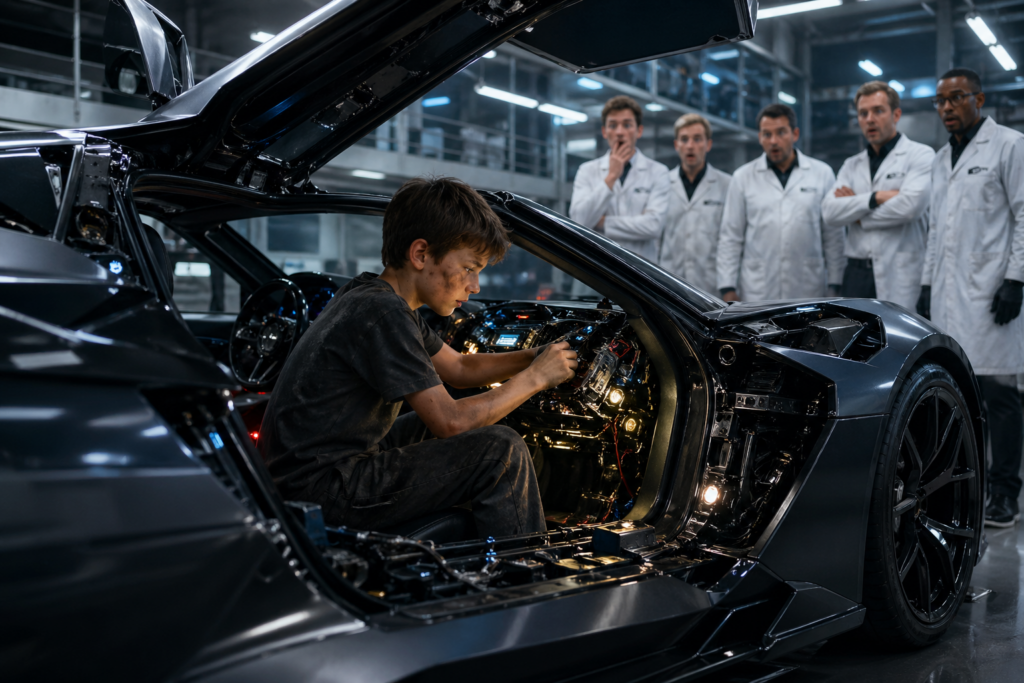
The warehouse smelled like oil, metal, and quiet disappointment. Bright white lights hung over a single car in the center of the room—low, sharp, and beautiful in a way that used to make people stop talking when they saw it. Now it just sat there, silent. Dead. It had a name once, a reputation, a future people wrote headlines about before it ever touched a road. Now it was just a project no one wanted to talk about anymore. A machine too advanced to fail—that had failed anyway.
Around it stood men who were used to solving problems. Senior engineers, specialists, people who had spent decades building things others couldn’t understand. And yet none of them had touched the car in over an hour. There was nothing left to try.
“We’ve checked everything,” one of them muttered. “It’s not mechanical.”
“Then what is it?” another asked.
No one answered. Because admitting we don’t know wasn’t something they were used to.
Finally, the lead engineer sighed. “Shut it down. We’re done.”
Laptops closed. Tools were set aside. One by one, they walked out, leaving the car alone under the lights.
Except it wasn’t alone.
At the far end of the warehouse, near the open service door where cold air slipped in, a boy stood quietly behind stacked crates. He looked about twelve. His clothes were worn, smudged with dirt and oil, like he belonged to places no one noticed. He had been there the whole time, watching, listening.
Waiting.
When the last door closed, he stepped forward.
Slowly at first. Carefully. But his eyes stayed locked on the car—not with curiosity, not with awe—but recognition.
That was the strange part.
He walked around it once, then again, like he was remembering something instead of discovering it. His fingers hovered near the surface, then he opened the driver’s door without hesitation and climbed in.
The dashboard flickered to life faintly.
He didn’t look confused. He looked focused.
His hands moved fast, precise. He didn’t check the obvious things. Instead, he reached beneath the steering column and opened a small hidden panel most people wouldn’t even notice. Inside were wires and control modules. He stared at them briefly, then adjusted one connection, cleaned a contact with his sleeve, and pushed it back in tighter.
Then he moved to the console.
Typed something.
Deleted it.
Rewrote it.
His fingers moved like he had done this before.
Outside, voices echoed—the engineers were coming back.
The door opened.
They stopped instantly when they saw him.
“Hey! What are you doing?!” one shouted.
The boy didn’t panic. Didn’t even look up. He finished what he was doing, then calmly pressed the ignition.
For a second—nothing.
Then—
The engine roared.
Not weak. Not struggling. Perfect. Alive.
The entire room froze.
That wasn’t supposed to happen.
The lead engineer stepped forward slowly. “What did you just do?”
The boy finally looked up. Calm. Certain.
“You were looking in the wrong place,” he said.
The man stared at him.
“That system wasn’t broken,” the boy continued. “It was protecting itself.”
They didn’t fully understand—but now they were listening.
“You designed it to shut down if the signal loop doesn’t match,” the boy said. “But the timing was off.”
The lead engineer’s expression shifted. “How do you know that?”
The boy paused for a second.
Then said something that made everything feel different.
“I didn’t know,” he said quietly. “I remembered.”
Silence.
Because that didn’t make sense.
“What do you mean remembered?” the engineer asked.
The boy reached into his pocket and pulled out a small folded paper. He handed it over.
The engineer opened it.
His face changed instantly.
It was a blueprint.
Original.
Hand-drawn.
Signed.
By the man who designed the car.
A man who had died years ago.
The engineer looked back at the boy slowly. “What’s your name?”
The boy met his eyes.
“Elian,” he said. Then after a pause, “Elian Voss.”
The name hit hard.
Everyone knew it.
Voss—the creator. The genius behind the car. The one who never finished it.
The engineer shook his head slightly. “Voss didn’t have a son.”
The boy didn’t argue. He just looked back at the car.
“He didn’t know,” he said.
And suddenly nothing felt simple anymore.
The car wasn’t dead.
The problem wasn’t impossible.
And the boy who fixed it—
shouldn’t have known how.
But he did.
And now the machine that everyone gave up on was running—
like it had been waiting for him.
