

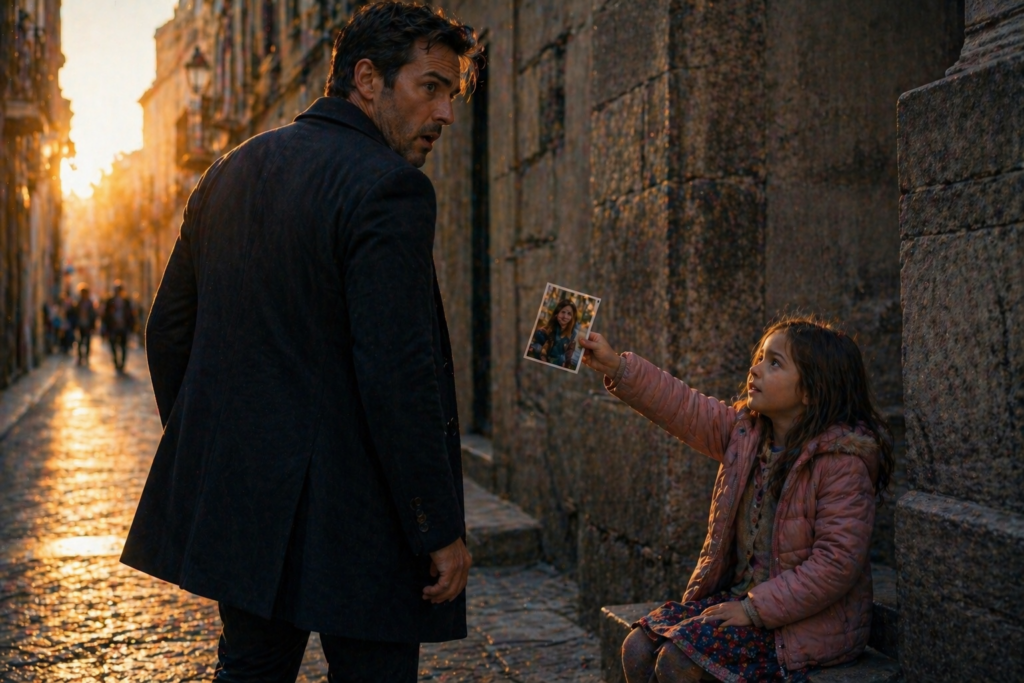
The street was quiet in that strange way evenings sometimes are—not empty, but softened. Golden light rested on old stone walls, and dust moved gently in the air, stirred by passing footsteps that never stayed long enough to matter.
Luca Moretti walked through it all without seeing any of it.
His pace was steady, but not relaxed. His shoulders were tight, his jaw set, his mind somewhere far behind him, tangled in thoughts he had been carrying for years. People passed him, but he didn’t notice. The world moved. He didn’t.
Then something small slipped from his coat pocket—a photograph.
It fell without sound, turning once in the air before landing near the edge of a low stone step. Luca kept walking. He never saw it.
But someone else did.
A little girl sat there, her legs tucked beneath her, a soft pink jacket wrapped around her shoulders. She had been drawing circles in the dust with a stick, lost in her own quiet world—until the photograph landed near her shoe.
She picked it up without thinking. Just curiosity. Just something new.
But the moment she looked at it, everything changed.
Her fingers tightened slightly around the edges. Her eyes widened—not with fear, not with confusion—but with recognition.
She lifted her head slowly and looked down the street at the man walking away.
Then, in a voice small but impossibly clear, she called out:
“Mister… why do you have a picture of my mom?”
Luca stopped.
Not suddenly. Not sharply. Just enough—like something inside him had pulled a thread too tight. His step froze. His breath caught somewhere between in and out.
Then he turned.
Slowly. Too slowly.
Because something in that question already felt wrong. Already felt impossible.
The girl held the photograph up with both hands. The fading sunlight caught it just right.
A woman smiled from the image—soft eyes, dark hair, a warmth that didn’t belong to memory. It belonged to someone real.
Luca stared at it. Then at her.
His voice came out lower than he expected.
“What did you say?”
The girl blinked once, completely certain.
“My mom.”
The word hit harder than anything else.
Luca took a step toward her. Then another. But his movement wasn’t steady anymore. It was uncertain—like the ground beneath him had shifted into something unfamiliar.
When he got close enough to see her face clearly, the air left his lungs.
There it was.
Something he couldn’t explain—in her eyes, in the shape of her mouth, in the quiet way she held the photo like it mattered.
Like it belonged to her.
“That’s…” he started, but his voice faltered. “That’s my wife.”
The girl didn’t react to that. Didn’t argue. She just looked at him.
Then she shook her head gently.
“No,” she said softly. “She’s my mom.”
Luca felt something inside him tighten painfully.
“That’s not possible,” he whispered. “She—”
He stopped himself. But the words came anyway.
“She died.”
The girl hugged the photograph to her chest for a moment, then carefully held it back out toward him.
“No,” she said again. “Mom is alive.”
Luca’s hand lifted slowly toward the picture—but it didn’t reach it. It stopped halfway, because something inside him didn’t want to touch it. Didn’t want to confirm what it might mean.
Then the girl said it—the one sentence that broke everything he had built to survive.
“She told me… if I ever saw your face… not to let you walk away again.”
The world didn’t stop, but it felt like it did.
The light, the air, the sound—everything pressed into that one moment.
Luca stood there, frozen in the golden evening, staring at the child like something impossible had just taken shape in front of him.
Because years ago, his wife had disappeared in a fire.
There had been smoke. Collapsed beams. A ring found near the ruins. Enough evidence for everyone else. Enough to close the story—even without a body.
He had searched. At first desperately. Then relentlessly. Then longer than anyone believed was reasonable.
Until grief stopped feeling like love—and started feeling like something that would destroy him if he didn’t let it go.
So he did.
Or at least, he told himself he did.
Now, a little girl stood in front of him holding his photograph. Calling that same woman “Mom.” And speaking like she had been sent.
“Where is she?” Luca asked.
His voice didn’t belong to him anymore.
It sounded thinner. Fragile.
The girl looked down the street, then back at him.
But instead of answering, she asked:
“Why didn’t you come before?”
The question didn’t accuse. It didn’t blame. It just existed.
And somehow that made it worse.
Because how do you explain to a child that you believed what everyone told you? That you accepted loss because hope became too painful to carry?
Luca lowered himself slowly to her level. His breathing uneven now.
“What’s your name?” he asked.
She told him.
And the moment she did, everything inside him collapsed.
Because it was the name—the one he and his wife had chosen years ago. For a child that never came. A name they had never told anyone. Never written down. Never spoken outside their home.
Luca stared at her. Then at the photograph. Then back at her again.
The truth didn’t arrive all at once. It formed slowly, piece by piece.
His wife had survived.
She had escaped.
But not alone.
Pregnant.
Hidden.
Forced into silence by someone who needed her gone.
The girl’s voice trembled slightly now.
“Mom said… some people told you she was dead.”
Luca closed his eyes for a second.
Not long.
Just enough.
Because that was it.
Not fate. Not accident.
A lie.
His expression changed. Grief shifted into something sharper. More awake.
“Is she hurt?” he asked.
The girl nodded.
“She’s sick.”
A pause.
Then quietly:
“She waits near the old church… every Thursday… just in case you still love her.”
That was the moment everything broke.
Not loudly. Not violently.
Just enough.
Enough for years of silence, loss, and missed time to collapse inward all at once.
The girl stepped closer and placed the photograph back into his hand. Her small fingers lingered for a second.
Then she said softly:
“She told me… if you looked sad before you smiled… then I found the right person.”
Luca looked down at the picture. Then at her. Then toward the end of the street—where the light was fading into night.
And for the first time in years, he didn’t feel like he was chasing something lost.
He felt like he was finally being led back to it.
