

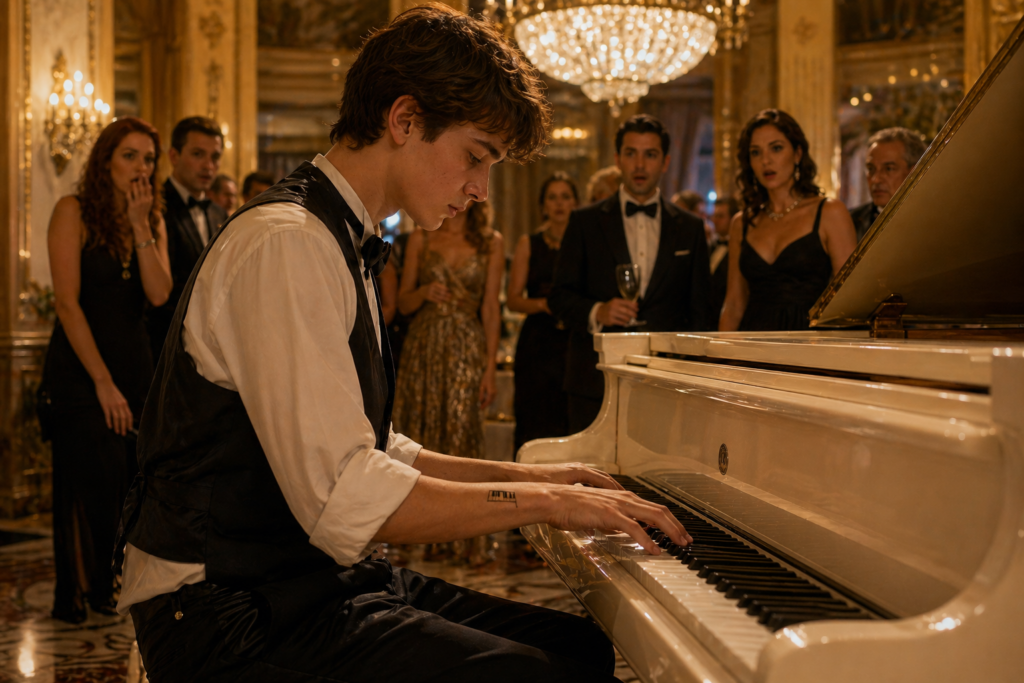
The ballroom glowed under layers of crystal light, reflections dancing across marble floors polished to perfection. Conversations blended into a soft hum, laughter rising and falling like background music, while glasses clinked gently in practiced elegance.
This was the kind of place where no one needed to prove anything.
Everything already spoke for them.
At the center of the hall stood a white grand piano—immaculate, untouched, almost decorative. It wasn’t there to be played. It was there to be admired.
And no one had gone near it all evening.
Except one person.
Near the edge of the room, barely noticeable among the movement of servers and guests, stood a thin boy in a fitted black uniform. His name was Leo. Sixteen, maybe. Quiet. Invisible in the way people become when no one expects anything from them.
In his hands, a tray of champagne glasses rested steadily.
But his eyes—
His eyes never left the piano.
Not once.
Every note from the background music felt wrong to him. Too distant. Too empty. Like something important was missing.
He swallowed.
Waited.
Watched.
Then, before he could lose the courage, he stepped forward.
Each step felt louder than it should have.
He stopped a few feet from a group of guests, where a tall man in a tailored gray suit stood at the center, clearly someone important.
Leo hesitated… then spoke.
“Excuse me… may I try the piano?”
The conversation paused just enough to notice him.
The man looked down slowly, his eyes scanning the uniform, the tray, the boy.
Then a faint smile appeared.
Not kind.
Amused.
“You?” he said. “That’s not a toy.”
A couple of people nearby chuckled softly.
Leo felt the familiar heat rise to his face.
The old instinct returned—apologize, step back, disappear.
But this time—
He didn’t.
He simply nodded once.
Carefully placed the tray on a nearby table.
And walked to the piano.
No permission.
No second question.
Just—
certainty.
A quiet ripple moved through the room. Some guests leaned in slightly, curious. Others turned away, already expecting nothing.
Leo sat down on the bench.
For a moment, he didn’t move.
His hands hovered above the keys.
Not nervous.
Remembering.
As his sleeve shifted, a small marking appeared on his wrist—a simple sketch of a piano key, faded but intentional.
Across the room, the man in the gray suit stopped smiling.
Something about that symbol—
It hit a memory.
Leo pressed the first key.
The sound was soft.
Clean.
Then another.
Within seconds, the room changed.
The quiet testing of notes turned into a melody so full, so alive, that conversations didn’t stop—they faded, naturally, like they were no longer needed.
People turned.
One by one.
Glasses paused mid-air.
Eyes focused.
Because this wasn’t just skill.
This was something deeper.
Every note carried feeling—loss, warmth, longing, something unfinished. It didn’t sound like a performance.
It sounded like truth.
The music filled the hall, wrapping around every corner, every person, every silent realization.
Near the piano, the man’s expression tightened.
Years ago, a short video had circulated privately. A child sitting beside an old train station, playing a broken keyboard with impossible emotion. No name. No background.
Just music.
And one detail—
Drawn next to the instrument in chalk.
A small piano key.
The man took a slow step forward.
“…No way,” he whispered.
Leo didn’t stop playing.
But something in his expression shifted—just slightly.
Acknowledgment.
The final note faded slowly, like it didn’t want to leave the room.
Silence followed.
Deep.
Heavy.
Then—
Applause.
One person.
Then another.
Then the entire hall.
People stood.
Not out of politeness.
Out of something real.
Leo lowered his hands slowly.
For a second, he looked uncertain again—like he had shown too much.
The man stepped closer now, no trace of mockery left.
“What’s your name?” he asked.
“…Leo,” the boy replied.
The name meant nothing.
But the music still echoed.
“Where did you learn that?” the man asked quietly.
Leo glanced at the piano, then down at his hands.
“My grandfather,” he said. “Before he passed.”
A small pause.
“I used to play at the station after that… until we had to leave.”
“Why stop?” the man asked.
Leo hesitated.
Then answered simply.
“Because music doesn’t pay rent.”
The words landed heavier than the applause.
Around them, the room shifted.
Luxury felt different now.
Smaller somehow.
The man exhaled slowly.
“I was wrong,” he said.
Leo shook his head.
“You just didn’t know.”
That answer stayed with him.
Because it was true.
The man looked at the piano.
Then back at Leo.
“Play again,” he said. “Not for them. For yourself.”
Leo hesitated.
Then placed his hands back on the keys.
And this time—
No one spoke.
No one laughed.
They just listened.
Months later, the same melody echoed through a different hall—larger, brighter, filled with people who came not for a party, but for him.
On stage, under a single light, Leo sat at a grand piano.
No uniform.
No tray.
No invisibility.
When he played, the feeling was the same.
Unchanged.
Real.
And somewhere in the audience, the man who once laughed sat quietly, hands still, eyes reflecting something deeper than pride—
Respect.
Because sometimes, the person no one notices…
is the one the world was always meant to hear.
