

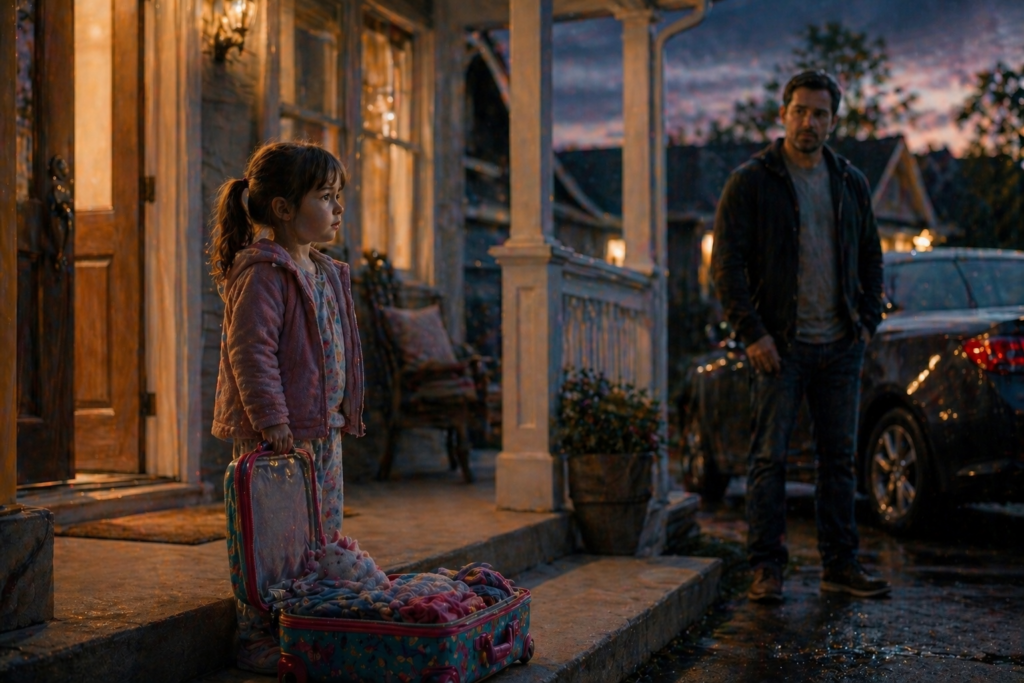
When Evan Cole pulled into the driveway, the first thing he noticed was not the porch light.
It was the suitcase.
Small. Pink. Covered in faded stars and tiny cartoon animals. It stood beside the front steps like something placed there by mistake.
Then he saw his daughter.
Four-year-old Sophie was standing beside it in her pajamas, her little coat zipped halfway, one shoe tied and the other loose. Her cheeks were red from crying. Her hair was messy, as if she had tried to fix it herself and given up.
The house behind her was dark and silent.
Too silent.
Evan turned off the engine but didn’t move for a second. After twelve hours at work, his mind was slow, heavy with deadlines, traffic, and the kind of exhaustion that settles deep in the bones. But the sight of Sophie outside alone in the cold cut through all of it.
He got out fast.
“Sophie?”
She looked up, and her face crumpled instantly.
“Daddy,” she whispered.
He hurried up the path and dropped to one knee in front of her.
“What are you doing out here? Where’s Claire?”
Sophie didn’t answer.
Instead, she gripped the handle of her suitcase with both hands.
“I’m leaving,” she said.
Evan stared at her.
For a moment, the words didn’t make sense. They were too big for her. Too serious. Children said things like that when they were angry about bedtime or vegetables. But Sophie wasn’t pouting.
She was shaking.
“Leaving?” he asked gently. “Where are you going, sweetheart?”
She swallowed hard.
“I don’t know.”
That answer frightened him more than anything else could have.
Evan looked toward the house again. No movement behind the curtains. No sound from inside. His wife’s car was parked in the garage, visible through the side window.
He reached for Sophie’s cold hands.
“Baby, why are you outside?”
Her lower lip trembled.
“I can’t live in there anymore.”
The cold air seemed to press against Evan’s chest.
He kept his voice soft. Very soft.
“Why not?”
Sophie glanced over her shoulder at the front door, then leaned closer to him as if the house itself might hear.
“Because of your wife.”
Evan went still.
Not Mommy.
Not Claire.
Your wife.
The words landed in a place he didn’t know existed.
Claire had been in Sophie’s life for only ten months. Evan’s first wife, Sophie’s mother, had died when Sophie was two. For a long time, it had been just the two of them—breakfasts with spilled cereal, bedtime stories read twice, tiny shoes by the door, drawings taped to the refrigerator.
Then Claire came in.
Patient. Polished. Kind in the beginning.
At least, that was what Evan had believed.
He had wanted to believe it.
He had wanted a family again, or some version of one.
Sophie’s eyes filled with tears.
“She’s a monster,” she whispered.
Evan felt his stomach tighten.
Children used that word for shadows, for closet doors left open, for strange noises in the dark. But the way Sophie said it was different.
Not dramatic.
Not silly.
Tired.
“What did she do?” he asked.
Sophie shook her head quickly.
“She said not to tell.”
Evan’s pulse changed.
He could feel it in his throat now.
“Did she hurt you?”
Sophie looked down.
That was all it took.
The world narrowed.
The driveway. The suitcase. His daughter’s tiny fingers gripping the plastic handle. The silent house behind them.
Evan forced himself to breathe. Forced himself not to storm through the door. Not yet. Not before he understood.
He took Sophie into his arms. She clung to him instantly, wrapping both arms around his neck so tightly that he had to steady himself.
“You’re safe,” he whispered. “I’m here now.”
She cried then. Not loudly. Not the wild cry of a child throwing a tantrum. It came in small broken sounds, as if she had been holding it in for too long.
Evan picked her up, suitcase in his other hand, and carried her back to the car instead of the house.
She stiffened.
“No,” she cried. “No, Daddy, don’t make me go back inside.”
“We’re not going inside,” he said immediately. “We’re just sitting in the car where it’s warm.”
He buckled her into the back seat, turned on the heat, and sat beside her with the door open. The dashboard glowed softly. Warm air slowly filled the small space.
“Tell me what happened,” he said.
Sophie rubbed her eyes with her sleeve.
“She gets mad when you leave.”
Evan listened.
“She says I make too much noise. She says big girls don’t cry. She says if I tell you, you’ll be sad and go away too.”
Evan closed his eyes for half a second.
When he opened them, Sophie was watching him carefully, like she was afraid his face might change into someone else’s.
“I’m not going away,” he said.
Sophie nodded, but she didn’t look convinced.
“She put my bunny in the trash.”
Evan felt a sharp pain behind his ribs.
The bunny.
A gray stuffed rabbit with one stitched ear, worn thin from years of being held. Sophie’s mother had bought it before she got sick. Sophie slept with it every night.
“She said it was dirty,” Sophie continued. “I cried, so she locked the door.”
“What door?”
“My room.”
Evan’s hands tightened slowly.
“How long?”
Sophie shrugged the tiny, helpless shrug of a child who doesn’t measure time the way adults do.
“Until it was dark.”
He thought back to the last few weeks.
The quiet dinners. Sophie barely speaking. Claire explaining that Sophie was “adjusting.” Sophie suddenly wetting the bed after months of not doing it. Sophie clinging to him when he left for work. Claire saying he was spoiling her.
He had accepted too much.
Explained away too much.
Sophie unzipped the suitcase with trembling hands.
Inside were pajamas, a coloring book, mismatched socks, a plastic cup, and a framed photograph wrapped in a shirt.
Evan recognized it immediately.
Sophie’s mother.
In the photo, Hannah was sitting under a tree, holding baby Sophie against her chest, smiling at the camera like the world had not yet taken anything from her.
Sophie touched the frame carefully.
“I was going to find Mommy’s house,” she said.
Evan’s throat closed.
“She’s not there, baby,” he said softly.
“I know,” Sophie whispered. “But I thought maybe Grandma would know.”
Grandma lived two hours away.
Sophie had planned to walk.
At four years old.
In the dark.
With one shoe untied.
Because being alone outside had felt safer than staying inside.
That realization did something to Evan that anger alone could not.
It hollowed him out.
Then it filled him with a calm so cold it frightened him.
He closed the suitcase.
“Stay here,” he said gently. “I’m going to get your bunny.”
Sophie grabbed his sleeve.
“No, Daddy.”
“It’s okay.”
“She’ll be mad.”
Evan looked at his daughter’s small hand wrapped around him.
“No,” he said. “Not anymore.”
He stepped out of the car and walked to the front door.
The house smelled like lavender candles and silence.
Claire appeared at the top of the stairs in a robe, her hair neatly tied back, face tense but controlled.
“There you are,” she said. “I was wondering when you’d come in.”
Evan looked at her.
For the first time, he didn’t see the woman he had married. He saw the pauses in Sophie’s voice. The suitcase. The fear.
“Where’s the rabbit?” he asked.
Claire blinked.
“What?”
“Sophie’s bunny. Where is it?”
Claire sighed, already irritated.
“Evan, she is manipulating you. She had a tantrum because I asked her to clean her room.”
“Where is it?”
His voice did not rise.
That made Claire hesitate.
“In the trash outside,” she said. “It was disgusting.”
Evan turned and walked through the kitchen to the back door. He opened the trash bin and found the rabbit near the top, wrapped in paper towels. Wet, stained, but there.
He picked it up carefully.
Behind him, Claire’s voice sharpened.
“You can’t keep rewarding this behavior. She needs boundaries.”
Evan turned slowly.
“She was outside with a suitcase.”
Claire folded her arms.
“She’s dramatic.”
“She’s four.”
“She needs discipline.”
“She was afraid to come back inside.”
For the first time, Claire’s expression flickered.
Only for a second.
Then it hardened.
“She’s turning you against me.”
Evan stared at her, almost amazed.
There it was.
Not concern.
Not shock.
Not shame.
Just annoyance that she had been exposed.
He looked past her toward Sophie’s room. The door was closed. A small scratch mark near the handle caught his attention, pale against the painted wood.
He walked to it.
Claire followed.
“Don’t start searching the house like I’m some criminal.”
Evan opened the door.
The room was too clean.
That was the first thing he noticed.
Sophie’s room had never been perfectly clean. There were always crayons, picture books, tiny socks, dolls tucked under blankets. Now everything looked arranged. Controlled.
On the dresser sat a small plastic plate with half a sandwich dried at the edges. Beside it, Sophie’s night-light was unplugged.
He remembered what Sophie had said.
Locked in until dark.
He turned to Claire.
“Did you lock her in here?”
Claire’s face tightened.
“For her own safety. She was hysterical.”
Evan felt the last fragile thread inside him snap.
He didn’t shout.
He didn’t argue.
He walked downstairs, picked up Sophie’s coat from the hook, grabbed her medicine from the cabinet, and took the folder with her birth certificate and insurance card from the drawer.
Claire stood in the hallway watching him.
“What are you doing?”
“Leaving.”
“You’re being ridiculous.”
He passed her without answering.
She followed him to the door.
“You can’t just take her.”
Evan stopped then.
Turned.
“She is my daughter.”
“I’m your wife.”
He looked at her for a long moment.
Then said, “That’s going to change.”
Outside, Sophie was still in the car, eyes wide and terrified until she saw the rabbit in his hand.
She reached for it like it was proof the world had not ended.
Evan buckled himself in, locked the doors, and drove away from the house without looking back.
For the first mile, neither of them spoke.
Then Sophie’s small voice came from the back seat.
“Are we going to Grandma’s?”
“Yes,” Evan said.
“Is your wife coming?”
“No.”
A long silence.
Then—
“Ever?”
Evan looked at her in the rearview mirror.
Her eyes were heavy from crying. Her face was still blotchy, her bunny pressed beneath her chin.
“No,” he said. “Not ever.”
Sophie watched him in the mirror for a moment, as if testing whether the promise was real.
Then she whispered, “Okay.”
By the time they reached the highway, snow had started to fall lightly. The road ahead stretched dark and empty, but for the first time that night, Evan did not feel lost.
At a gas station halfway to his mother’s house, he stopped and bought Sophie warm milk and a pair of socks with little stars on them because her feet were cold. She sat in the back seat, wrapped in his coat, holding the rabbit with both hands.
When he came back, she was asleep.
Her face had softened.
But one hand still clutched the suitcase handle.
Evan stood outside the car for a moment and looked at her through the window.
He thought about all the signs he had missed.
The quietness.
The fear.
The way Sophie had stopped singing in the mornings.
The way she had started asking if he really had to go to work.
He had thought time would heal the missing space Hannah left behind.
Instead, while he was trying to rebuild a home, someone had made his child afraid of it.
He got back into the car and drove on.
His mother opened the door before he even knocked. He had called from the road, and she was waiting in a robe, face pale with worry.
The moment Sophie saw her, she woke just enough to reach out.
Grandma took her in without asking questions first.
That came later.
After Sophie was in a warm bed.
After the rabbit had been washed carefully by hand and set beside her pillow.
After Evan sat at the kitchen table across from his mother and told her everything in a voice that sounded too calm to belong to him.
By morning, calls would be made.
Locks would be changed.
A lawyer would be contacted.
Sophie would be protected.
But that night, Evan sat beside his daughter’s bed and watched her sleep.
At some point, she woke just enough to whisper his name.
“I’m here,” he said.
“Don’t let me go back,” she murmured.
He took her hand.
It was so small inside his.
“I won’t.”
She fell asleep again.
And Evan stayed there until sunrise.
The little pink suitcase sat by the door, still packed with socks, crayons, and the photograph of the mother Sophie had been trying to find.
Evan looked at it for a long time.
That suitcase should never have been packed.
A child should never have to plan an escape from her own home.
But she had.
And because she did—
Because she stood outside in the dark and told the truth in the only way she knew how—
Her father finally saw what had been happening behind the walls he thought were safe.
By morning, the house they had left behind no longer felt like home.
But the room where Sophie slept, warm and protected, did.
And for the first time in months, she woke up without crying.
