

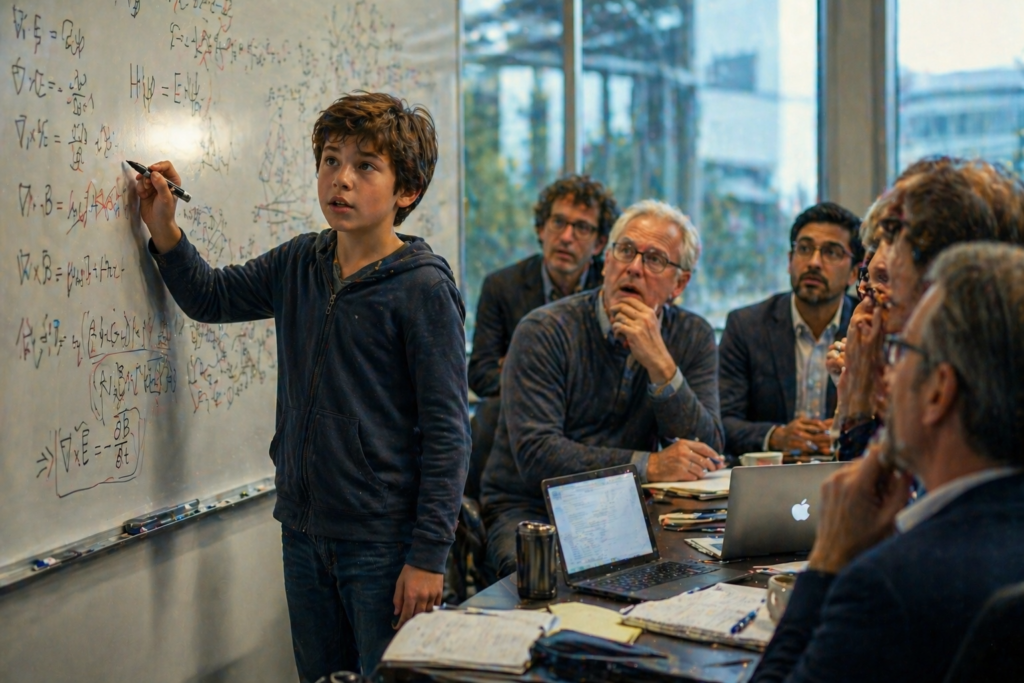
At eleven years old, Adrian Keller didn’t look like someone who would challenge a room full of scientists.
He looked like a quiet kid who forgot to comb his hair.
His hoodie sleeves were always a little too long, his notebooks filled with messy pages of numbers and crossed-out ideas. In class, he rarely raised his hand. He spent more time staring at equations than listening to explanations, not because he didn’t understand—but because something about them didn’t feel right.
Adrian had a habit that made teachers uneasy.
He didn’t accept things just because they were taught.
He needed them to make sense.
It started late one evening when he was watching a university lecture online. It was a presentation about a new scientific model—something that had already been praised, published, and accepted by people far more experienced than him.
The speaker moved confidently through complex equations, explaining how the system behaved, how it remained stable, how everything fit perfectly together.
Too perfectly.
Adrian paused the video.
Rewound.
Watched the same section again.
At first, it was just a feeling. A small discomfort, like a note slightly out of tune. He couldn’t explain it yet, but he knew something wasn’t right.
He grabbed his notebook.
Started writing.
Numbers came first.
Then small adjustments.
Then corrections.
He followed the equation step by step, carefully rebuilding it, not trusting anything he hadn’t checked himself.
Hours passed.
His desk filled with pages.
Some crumpled.
Some covered in arrows and rewritten calculations.
He kept going.
Because the more he looked, the clearer it became.
There was a flaw.
Not a big one.
Not something obvious.
Something small.
Hidden.
The kind of mistake that didn’t break the equation immediately—but slowly, over time, changed everything.
By morning, Adrian had something no one else seemed to see.
He didn’t think about whether he should speak up.
Only whether he was right.
He wrote an email.
Simple.
Direct.
He explained where the equation didn’t hold. Where the assumption failed. What happened when it did.
At the end, he added one sentence:
“I might be wrong, but I checked it many times.”
Then he sent it.
And went to school.
Three days passed.
Nothing.
On the fourth, a reply came.
Short. Polite.
Dismissive.
They thanked him for his interest and assured him the model had been reviewed thoroughly. There was no issue.
Adrian read it once.
Then closed it.
He didn’t feel embarrassed.
He didn’t feel discouraged.
He just went back to his notebook.
Because confidence didn’t mean something was correct.
He stopped trying to explain.
Instead, he decided to show.
He rebuilt the entire model from the ground up, line by line, using their assumptions first. Then, slowly, he introduced his correction.
The difference appeared immediately.
Their version predicted stability.
His didn’t.
At first, it was small—almost invisible.
Then it grew.
Until the system no longer held together.
Something they had overlooked—a tiny variable, dismissed as insignificant—began to change everything.
Adrian ran the numbers again.
And again.
Each time, the result stayed the same.
He didn’t write another long explanation.
This time, he sent the data.
No arguments.
Just results.
The reply came faster.
Not dismissive anymore.
Curious.
They asked how he reached the conclusion.
Adrian answered.
Clearly. Simply.
Step by step.
A week later, his school received a call.
Then another.
Then an email.
The university wanted him to come in.
Not for a visit.
For a discussion.
His teacher thought it was a misunderstanding.
His parents were unsure.
Adrian packed his notebook.
That was enough for him.
The room was larger than anything he was used to.
Glass walls. Long table. Quiet tension.
People who had spent decades studying what he had looked at for a few days.
They didn’t greet him like a child.
They greeted him like a problem.
He sat down.
Opened his notebook.
Waited.
The questions started carefully.
How he approached the model.
What assumptions he used.
Why he believed something was wrong.
Then the tone changed.
More precise.
More challenging.
They weren’t trying to dismiss him anymore.
They were trying to find the mistake.
His mistake.
Adrian answered everything.
He didn’t rush.
He didn’t guess.
If he didn’t know something, he said so.
If he did, he explained it clearly.
Until the questions stopped being about him—
And started being about the model.
One of them stood.
“Walk us through the failure point,” he said.
Adrian nodded.
He walked to the board.
Picked up a marker.
His hand didn’t shake.
He wrote the equation they had built.
Then paused.
Looked at it for a moment.
Then drew a line through one part.
“Here,” he said.
That was all.
One small change.
He rewrote the outcome beneath it.
Slower this time.
Making sure every step was clear.
When he finished, he stepped back.
The room went quiet.
Not confused.
Not skeptical.
Something else.
Recognition.
They saw it.
Not because he explained it perfectly.
But because it was there.
One of them leaned forward.
Another stood up.
Someone walked closer to the board.
No one spoke.
Because they didn’t need to.
The flaw was real.
It had always been there.
They had just missed it.
Days passed after that.
Then weeks.
The model was reviewed again.
Rebuilt.
Corrected.
And eventually, republished.
At the bottom of the paper, there was a small note.
Adrian Keller.
He didn’t ask for anything more.
Didn’t need recognition.
Didn’t celebrate.
Because to him, nothing had changed.
The equation was just finally correct.
Later, someone asked him how he noticed it.
Adrian thought for a moment.
Then said, “It didn’t feel right.”
That was all.
People expected something deeper.
Something impressive.
But that was the truth.
He didn’t find the mistake because he was trying to prove anyone wrong.
He found it because he couldn’t ignore something that didn’t make sense.
And he kept looking—
Until it did.
