

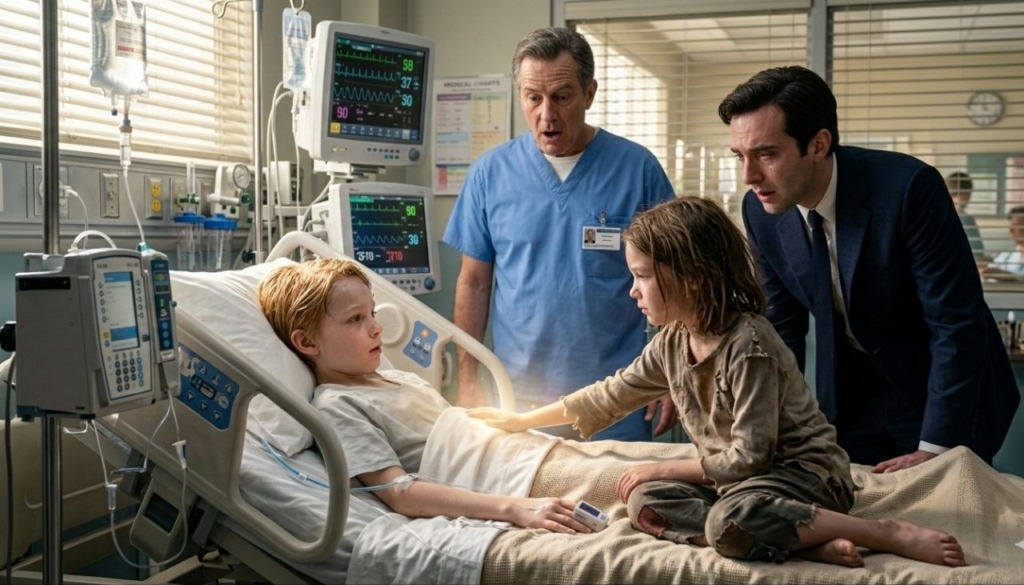
The hospital room was silent except for the faint beeping of machines. The rhythmic sound of the heart monitor echoed through the cold white walls, a constant reminder of the fragility of life. Sunlight slanted weakly through the blinds, casting stripes across the pale floor.
In the bed lay Alexander, a ten-year-old boy from one of the wealthiest families in the city. His golden hair lay damp against his forehead, his skin pale and almost translucent. For the past week, he had not opened his eyes. The illness had drained him, leaving him fragile and unresponsive, a shadow of the vibrant boy he had been just days ago.
At his side, Dr. Harris, a middle-aged man with tired eyes and a calm demeanor, checked the monitors again. His expression was careful, composed, but the worry etched into the lines of his face betrayed his true concern.
Beside the bed stood Alexander’s father, a tall man in a tailored suit who had spent his life commanding businesses and boardrooms. In this hospital room, all his authority felt useless. His hands clenched and unclenched at his sides as he watched the boy lying so still. He whispered his son’s name softly, almost hoping the sound of it could reach him.
“Dad…” came a tiny voice from the doorway.
They both turned to see a girl standing there. She was no older than Alexander, perhaps ten, dressed in tattered clothes, her feet bare, and her hair tangled around her face. Her skin was dusty, hands thin and small, a stark contrast to the sterile, polished hospital room. Her eyes, however, shone with something extraordinary—a quiet, unshakable warmth.
Alexander’s father frowned. “Who… who are you?”
The girl stepped closer, hesitating only a moment. “I… I just want to help,” she whispered. Her voice was soft but carried an unexpected certainty.
The doctor’s eyebrows knit together. “You can’t be here. You shouldn’t touch him. He’s very fragile.”
But the girl did not move away. Instead, she gently placed her hand on Alexander’s elbow. It was such a small, innocent gesture, yet the warmth that spread from her fingers seemed to fill the room.
The heart monitor beeped, steady at first, then hesitated, as if the machines themselves were sensing something impossible.
A faint light, no bigger than a pinprick, appeared where her hand touched Alexander’s arm. It was so subtle that Dr. Harris blinked twice, unsure if his eyes were playing tricks on him. The light grew slightly, illuminating the pale hospital sheets and reflecting softly on the boy’s face.
Alexander’s father gasped. “What… what is happening?”
The girl’s eyes remained focused on Alexander. “Shh… it’s okay,” she whispered. “Just a little more.”
For the first time in seven days, a sound came from the boy. A small, fragile breath, barely audible. His chest rose slightly, then fell again. The doctor leaned closer, checking the monitors. His eyes widened. The light was not harmful, the vitals were improving. Slowly, almost impossibly, Alexander’s eyelids fluttered.
His father’s heart raced. “Alexander? Can you hear me?”
The boy’s eyes opened—clear, bright, and alive. He blinked several times, taking in the unfamiliar room, the machines, and then, finally, the small girl touching his arm.
“Who… who are you?” he whispered, his voice weak but full of wonder.
The girl smiled faintly. “I’m just a friend,” she said. “I wanted to help you.”
Alexander’s father could barely speak. “He… he’s awake. He’s awake!”
Dr. Harris adjusted his stethoscope, still monitoring, but his usual skepticism was replaced with awe. “I’ve never seen anything like this,” he said quietly. “His vitals… they’ve stabilized almost instantly.”
Alexander tried to sit up, but his strength was fragile. The girl gently pressed her hand against his elbow again. The tiny light flickered once more, soft and warm, like a promise.
The boy smiled faintly, his eyes meeting hers. “Thank you,” he whispered. “I… I thought I would never wake up.”
The girl nodded, her smile calm and serene. “You just had to believe a little,” she said.
His father stepped closer, tears running down his cheeks. He looked at the girl, then at his son. “Who are you?” he asked again.
The girl did not answer. She only squeezed his elbow lightly, and the small light blinked once more before fading. Then she stepped back, her eyes meeting Alexander’s one last time. “Just remember… sometimes the smallest touch can bring the biggest light,” she said softly, before vanishing down the corridor as quietly as she had arrived.
Alexander lay back, the warmth still lingering in his arm, his eyes wide with wonder. He had survived the week, survived the illness that had almost claimed him. And he had seen something extraordinary—a reminder that hope could arrive in the most unexpected forms, even from someone who seemed so fragile herself.
Dr. Harris shook his head in disbelief. “I’ll… I’ll need to write this down. This… this shouldn’t happen.”
Alexander’s father held his son tightly, gratitude and awe flooding every part of him. “He’s alive… he’s really alive,” he said, his voice trembling.
Alexander looked at the empty hallway where the girl had disappeared and whispered softly, “Thank you… friend.”
Outside the hospital, the sun was beginning to set, painting the sky in shades of gold and pink. And in that quiet room, a miracle had occurred—not just the boy’s survival, but the quiet, unexplainable light that reminded everyone that even in the darkest moments, hope and wonder could appear in the most unexpected ways.
