

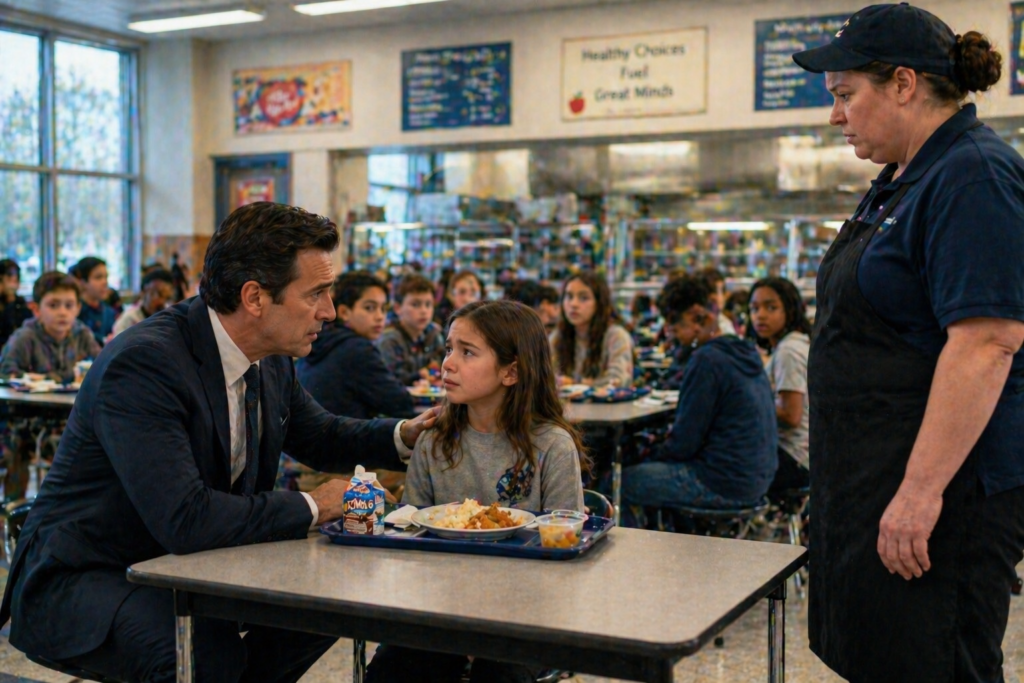
The cafeteria moved like it always did.
Trays sliding across metal rails. Laughter bouncing between tables. Chairs scraping the floor in uneven rhythm. Someone at the back dropped a drink, and a few kids laughed before going back to their conversations.
Nothing unusual.
Nothing important.
Just another school day.
At the far end, near the windows, sat a quiet girl named Mila.
She ate slowly, carefully, as if trying not to take up too much space. Her sweater sleeves were pulled over her hands, her eyes lowered to her tray.
She didn’t notice the tension building nearby.
Not until—
a tray hit the table in front of her.
Hard.
The sound cut through the noise, sharp enough to stop conversations mid-sentence. Food shifted, a bit spilling over the edge, the sudden impact making Mila flinch back in her seat.
She looked up, startled.
The cafeteria worker standing over her leaned slightly forward, her expression tight, her voice low enough that only the closest tables could hear.
“You need to pay attention,” she said. “This isn’t a place for carelessness.”
It wasn’t shouted.
But it wasn’t kind either.
Mila’s hands trembled slightly as she pulled them closer to herself.
“I—I’m sorry,” she whispered.
A few students nearby went quiet.
Others glanced over, unsure whether to keep watching or look away.
The worker straightened, clearly expecting the moment to end there.
It didn’t.
Because something else had already begun.
The doors at the far end of the cafeteria opened.
Not dramatically.
Just enough.
But the sound carried.
And the timing—
felt wrong.
A man stepped inside.
Early forties. Dark suit. Composed in a way that didn’t match the environment around him.
He paused for only a second.
Then his eyes moved.
Directly to Mila.
He didn’t need to ask.
He started walking.
Fast.
Not running—but purposeful enough that people instinctively moved aside.
The room shifted again.
Students straightened.
Whispers faded.
Even the staff behind the counter slowed.
The cafeteria worker noticed him only when he was already close.
“Sir, you can’t just—” she began.
He didn’t raise his voice.
Didn’t cause a scene.
He simply stepped between her and the girl.
“Step back,” he said.
Calm.
Controlled.
The kind of calm that didn’t invite argument.
The worker hesitated.
“I was just—” she tried again.
“I said step back.”
This time, there was no room for interpretation.
She took a small step away.
The man turned his attention to Mila.
His posture changed instantly.
Softer.
Lower.
He crouched slightly so he was at her level.
“Hey,” he said gently. “Look at me.”
Mila hesitated.
Then slowly lifted her eyes.
“You’re okay,” he added. “You didn’t do anything wrong.”
Her lip trembled.
Because no one had said that yet.
He glanced briefly at her tray, then back at her hands.
“You’re not hurt?” he asked.
She shook her head.
Still quiet.
Still shaken.
But listening.
He nodded once, then stood again.
And now—
the room felt different.
Because his attention shifted back to the worker.
“Your name,” he said.
It wasn’t a question.
The worker straightened, trying to regain control of the situation.
“I don’t see how that’s relevant,” she replied.
He held her gaze.
Long enough that her confidence began to slip.
“It’s relevant,” he said, “because I’ve been reviewing how this place operates.”
A ripple moved through the staff behind the counter.
The worker’s expression changed.
Slightly.
“What are you talking about?” she asked.
He didn’t answer immediately.
Instead, he looked around the room.
At the students.
At the phones some of them still held.
At the silence that had replaced the noise.
Then back at her.
“Patterns,” he said simply. “Behavior that doesn’t belong in a place like this.”
Her posture stiffened.
“You can’t just walk in here and—”
“I can,” he said.
Still calm.
Still controlled.
“Because starting today, this school reports directly to me.”
That landed.
Harder than anything else.
The worker blinked.
Trying to process.
Behind her, another staff member stepped forward slightly.
“Sir… you’re—”
“The new director,” he confirmed.
Now the whispers returned.
Not loud.
But everywhere.
The worker’s face drained of color.
He stepped closer—not aggressively, but with certainty.
“I’ve been going through reports,” he continued. “Watching how students are treated when they think no one important is around.”
He paused.
Just long enough.
“And I don’t like what I’ve seen.”
Silence deepened.
Because now—
this wasn’t just about one moment.
He turned slightly, gesturing toward Mila without looking away from the worker.
“This,” he said, “is exactly what I’m talking about.”
The worker opened her mouth.
Closed it.
Because there was nothing she could say that would change what had already happened.
The man took a breath.
Not out of anger.
Out of decision.
“You’ll need to speak with administration,” he said. “Immediately.”
It wasn’t shouted.
It didn’t need to be.
The meaning was clear.
The worker stepped back fully now.
Uncertain.
No longer in control.
The man watched her for a second longer.
Then turned away.
Back to Mila.
He crouched again, softer this time.
“Would you like something else to eat?” he asked.
She nodded slightly.
A small movement.
But real.
He smiled—just a little.
“We’ll fix that,” he said.
And as the cafeteria slowly began to move again—
quieter now, more aware—
everyone understood something had shifted.
Not just in that moment.
But in everything that would come after it.
