

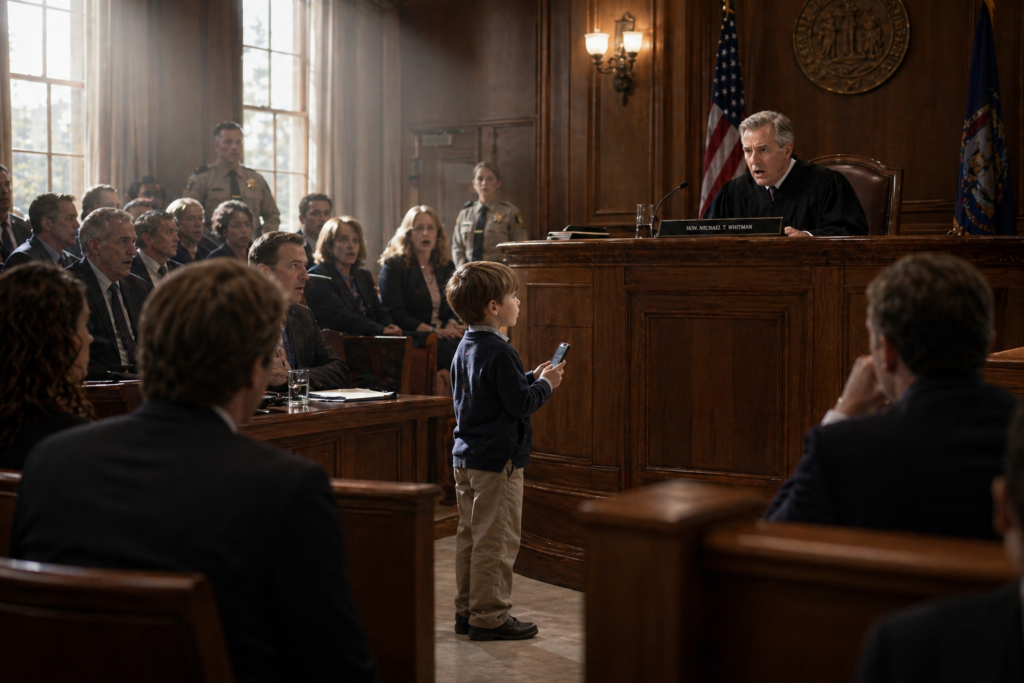
The courtroom had seen anger, fear, and desperation—but never confusion.
Morning light filtered through tall windows, stretching across polished wood and quiet rows of spectators. Lawyers adjusted their files, whispering final arguments, while deputies stood still at the walls like part of the structure itself.
At the center of it all sat Judge Michael Harrington.
Calm. Controlled. Certain.
He was known for that.
Nothing surprised him. Nothing rattled him. Years on the bench had taught him how to keep emotion out and order in.
He lifted the gavel and brought it down sharply.
“Order.”
The room settled immediately.
Or at least—it tried to.
Because just as the silence began to take hold, something unusual broke through it.
Footsteps.
Small ones.
Slow.
Uncertain—but not afraid.
Heads turned.
Conversations stopped.
A little girl—no older than six—was walking down the center aisle.
Alone.
She wore a light blue sweater slightly too big for her and had her hair tied in uneven braids. In both hands, she held a phone, gripping it carefully like it mattered more than anything else in the room.
For a moment, no one moved.
Then the whispers started.
“Whose child is that?”
“Is this part of the case?”
A deputy took a step forward, unsure whether to stop her.
But she kept walking.
Straight toward the bench.
Straight toward the judge.
Harrington leaned back slightly, watching her approach with mild curiosity—then with something closer to amusement.
This wasn’t normal.
But it also didn’t feel threatening.
“What is this?” he said, his voice calm but edged with authority. “Who brought you in here?”
The girl stopped just below the bench and looked up at him.
She didn’t look scared.
She didn’t look confused.
She looked… certain.
“I need to make a call,” she said.
A few people in the room chuckled quietly.
Even one of the attorneys shook his head, smiling.
The judge raised an eyebrow.
“In my courtroom?” he asked.
The girl nodded.
Harrington exhaled through a small smile, glancing briefly around the room as if to say this is new.
“Go ahead,” he said, leaning forward slightly. “Call whoever you think can help you.”
More laughter.
Light.
Dismissive.
The kind that fades quickly.
The girl didn’t react.
She tapped the screen of the phone carefully, then held it out in front of her, turning on the speaker.
The ringing filled the courtroom.
Clear.
Loud.
Uncomfortable.
One ring.
Two.
Three.
The judge crossed his arms lightly, still amused.
Then—
The call connected.
A voice came through instantly.
Sharp.
Direct.
“Michael? Why is she in a courtroom?”
Everything changed.
The judge’s smile vanished.
Not slowly.
Instantly.
Like something had been pulled away.
The room went silent.
Not a whisper.
Not a movement.
Just stillness.
Harrington leaned forward, gripping the edge of the bench.
“What did you just say?” he demanded.
The girl didn’t look at the phone.
She looked at him.
“You told me to call someone,” she said quietly.
The voice on the phone spoke again—lower now.
More serious.
“You said you handled it,” the man continued. “You said no one would ever find out.”
A ripple of tension moved through the room.
The bailiff shifted his stance.
One of the attorneys stopped writing mid-sentence.
Harrington stood halfway from his chair.
“This is not—” he started, but his voice failed him.
For the first time in years—
He didn’t sound certain.
The girl took a small step closer to the bench.
Still calm.
Still steady.
“You said I should wait until you were ready,” she said. “But you never came.”
The words didn’t sound like a child’s complaint.
They sounded like something remembered.
Something repeated.
The voice on the phone cut in again.
Colder this time.
“Tell her,” he said. “Right now.”
The judge’s hands tightened.
His eyes moved across the room—spectators, lawyers, officers.
All of them watching.
All of them waiting.
His control was slipping.
Not because of chaos.
But because of truth.
The kind that doesn’t need volume to break things apart.
The girl didn’t move.
Didn’t blink.
She just stood there, holding the phone, holding the moment.
“You said I couldn’t come here,” she added softly. “Because people would ask questions.”
The silence grew heavier.
No one laughed now.
No one moved.
The judge slowly lowered himself back into his chair.
For the first time, he didn’t look like a man in control.
He looked like someone being seen.
Not by the court.
Not by the law.
But by something far more difficult to face.
His past.
The voice on the phone spoke one final time.
“You promised you’d fix it,” it said.
The line went quiet.
The call ended.
But the silence didn’t.
It stayed in the room, pressing against every person there.
The girl lowered the phone slightly.
Still watching him.
Still waiting.
Because this time—
There was nowhere left for him to hide.
And no gavel strong enough—
to silence what had just been heard.
