

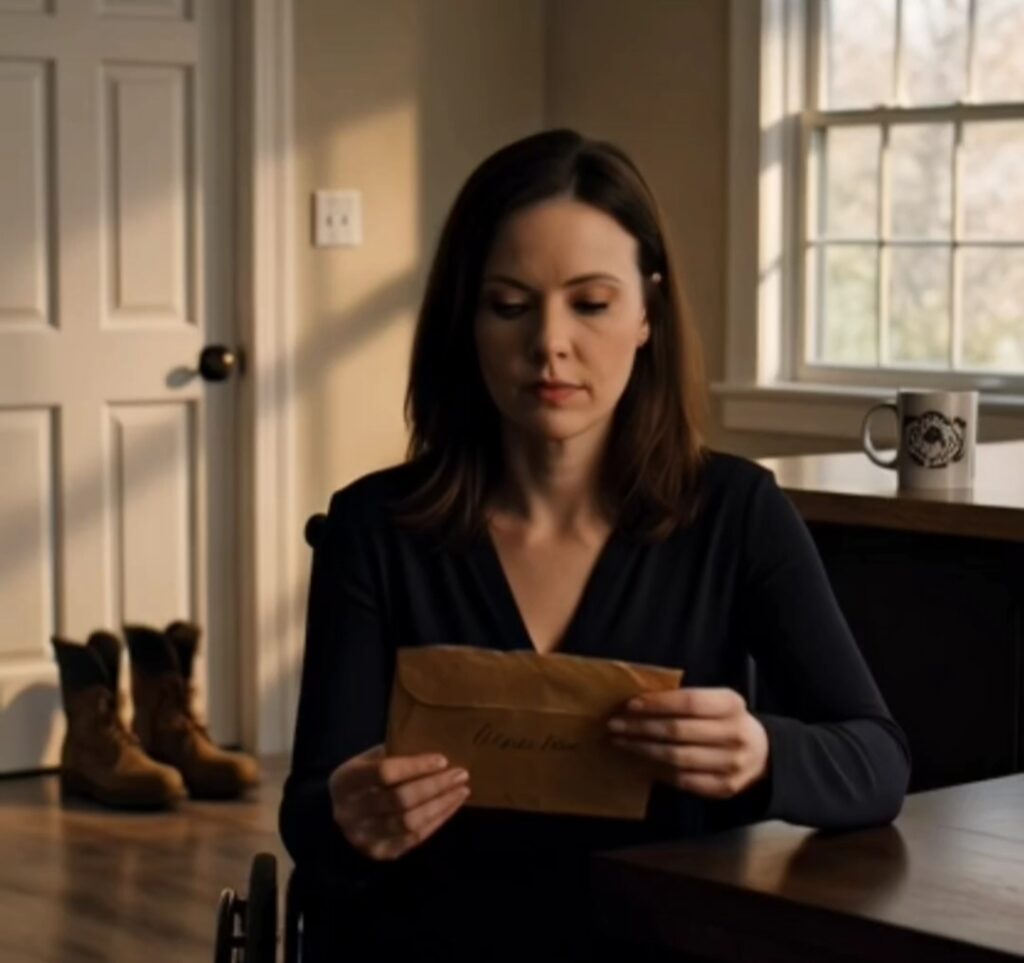
My uncle raised me after my parents died. After his funeral, I received a letter written in his rough handwriting that began with the words: “I’ve been lying to you your whole life.”
I was twenty-six years old, and I hadn’t walked since I was four.
Most people hear that and assume my story started in a hospital bed.
But I remember pieces of a “before.”
My mom, Rachel, used to sing loudly while cooking in the kitchen. My dad, Daniel, always smelled like motor oil mixed with peppermint gum. I had light-up sneakers, a purple sippy cup, and very strong opinions for a kid.
Then there was the crash.
I don’t remember it.
The story I grew up with was simple: there had been an accident, my parents died, and I survived—but my spine didn’t.
Afterward, the state started discussing “appropriate placements.”
Then my mother’s brother walked into the hospital.
The social worker, Susan, stood near my bed holding a clipboard.
“We’ll find a loving home,” she said gently. “We have families experienced with—”
“No,” Tom said.
She blinked. “Sir—”
“I’m taking her,” he said flatly. “I’m not handing her to strangers. She’s mine.”
Tom looked like he had been carved out of concrete and bad weather. Big hands, rough voice, permanent scowl.
But he took me home.
His house was small and always smelled like coffee. He had no kids, no partner, and absolutely no idea what he was doing.
So he learned.
He watched the nurses carefully and copied everything they did. He wrote notes in a worn notebook—how to roll me safely, how to check my skin, how to lift me gently but firmly.
The first night at home, his alarm rang every two hours.
He’d stumble into my room with messy hair and tired eyes.
“Pancake time,” he’d mutter while adjusting my position.
Sometimes I whimpered from pain.
“I know,” he’d whisper softly. “I got you, kiddo.”
Money was tight. Insurance fights were constant.
I remember him pacing the kitchen with the phone on speaker.
“No, she can’t just ‘make do’ without a shower chair,” he argued. “You want to tell her that yourself?”
They never did.
He built a rough plywood ramp outside the front door so my wheelchair could get in and out. It wasn’t pretty, but it worked.
Our neighbor, Mrs. Rodriguez, started bringing casseroles and offering advice.
“She needs friends,” she told him.
“She needs not to break her neck on your stairs,” he grumbled.
But later he pushed my wheelchair around the neighborhood, introducing me proudly to every kid like I was some kind of VIP.
At the park, kids stared.
Parents looked away.
Then a girl my age walked up.
“Why can’t you walk?” she asked bluntly.
I froze.
Tom crouched beside me.
“Her legs don’t listen to her brain,” he said calmly. “But she can beat you at cards.”
The girl laughed. “No, she can’t.”
That girl was Mia.
My first real friend.
Tom had a way of stepping into awkward moments and softening them.
When I was about ten, I found a chair in the garage with yarn taped to the back, clumsily braided.
“What’s this?” I asked.
“Nothing,” he muttered. “Don’t touch it.”
That night he sat behind me on the bed, hands trembling.
“Hold still,” he said, trying to braid my hair.
It looked terrible.
But I thought my heart would explode.
When I hit puberty, he came into my room holding a plastic bag and looking incredibly uncomfortable.
“I bought… stuff,” he said while staring at the ceiling.
Inside were pads, deodorant, and cheap mascara.
“You watched YouTube,” I guessed.
He grimaced. “Those girls talk very fast.”
We never had much money, but I never felt like a burden.
He washed my hair in the kitchen sink, one hand supporting my neck while he poured warm water with the other.
“It’s okay,” he’d say quietly. “I got you.”
Sometimes I cried because I’d never dance or simply stand in a crowd.
He’d sit beside me, jaw tight.
“You’re not less,” he’d say firmly. “You hear me? You’re not less.”
By my teenage years it was clear there would be no miracle cure.
Most of my life happened inside my room.
Tom turned that room into a whole world.
Shelves within reach. A strange tablet stand he welded together in the garage. On my twenty-first birthday he built a planter box by the window and filled it with herbs.
“So you can grow that basil you yell at on cooking shows,” he said.
I burst into tears.
“Jesus, Emily,” he said nervously. “You hate basil?”
“It’s perfect,” I cried.
He turned away awkwardly. “Yeah… well, try not to kill it.”
Then he started getting tired.
At first it was small things—moving slower, sitting halfway up the stairs to catch his breath, burning dinner.
“I’m fine,” he insisted. “Just getting old.”
He was fifty-three.
Mrs. Rodriguez finally cornered him in the driveway.
“You see a doctor,” she ordered. “Don’t be stubborn.”
Between her pressure and my begging, he went.
After the tests, he sat at the kitchen table with papers under his hand.
“What did they say?” I asked.
He stared past me.
“Stage four,” he said quietly. “It’s everywhere.”
“How long?” I whispered.
He shrugged. “They said numbers. I stopped listening.”
He tried to keep things normal.
He still made my eggs in the morning, even when his hands shook. He still brushed my hair, though sometimes he had to lean against the dresser to catch his breath.
Eventually hospice came.
A nurse named Laura set up a hospital bed in the living room. Machines hummed. Medication charts covered the fridge.
The night before he died, he asked everyone to leave.
“Even me?” Laura asked.
“Yeah,” he said gently. “Even you.”
He came into my room and sat in the chair beside my bed.
“Hey, kiddo.”
“Hey,” I said, already crying.
He took my hand.
“You know you’re the best thing that ever happened to me, right?”
“That’s kind of sad,” I joked weakly.
He chuckled softly. “Still true.”
“I don’t know what to do without you,” I whispered.
His eyes filled with tears.
“You’re gonna live,” he said firmly. “You hear me? You’re gonna live.”
“I’m scared.”
“Me too,” he admitted.
He looked like he wanted to say something else but only shook his head.
“I’m sorry,” he said quietly.
“For what?”
“For things I should’ve told you.”
Then he kissed my forehead.
“Get some sleep, Emily.”
He died the next morning.
The funeral was a blur of black clothes, weak coffee, and people saying, “He was a good man.”
Back home, the house felt wrong.
His boots by the door. His mug in the sink. The basil drooping in the window.
That afternoon Mrs. Rodriguez knocked and handed me an envelope.
“Your uncle asked me to give you this,” she said softly. “And to tell you he’s sorry. I am too.”
Inside were several pages.
The first line read:
“Emily, I’ve been lying to you your whole life.”
My chest tightened as I read.
The crash hadn’t happened the way I believed.
That night my parents had come to Tom’s house with my overnight bag. They told him they were moving away for a “fresh start.”
They weren’t taking me.
“They said you’d be better off with me,” the letter said. “I lost my temper.”
He screamed at them. Called my father a coward and my mother selfish.
He knew my dad had been drinking.
“I could’ve taken his keys,” he wrote. “Called a cab. Told them to stay. I didn’t. I let them drive away angry because I wanted to win.”
Twenty minutes later the police called.
Their car had wrapped around a pole.
They were gone.
I survived.
Tom explained why he never told me.
“At first, when I looked at you in that hospital bed, I saw punishment,” he wrote. “For my anger. Sometimes I even resented you. Not because of anything you did—but because you reminded me what my temper cost.”
But taking me home was the only right choice he had left.
Everything afterward, he wrote, was his attempt to repay a debt he could never repay.
Then he explained the money.
I had always believed we were barely surviving.
But my parents’ life insurance had been put in a trust under his name so the state couldn’t take it.
He worked endless overtime as a lineman—storms, overnight calls, dangerous jobs.
Some money kept us afloat.
The rest was saved.
“I sold the house,” he wrote. “I wanted you to have enough for real rehab, real equipment, real help. Your life doesn’t have to stay the size of that room.”
The last lines broke me.
“If you can forgive me, do it for yourself. So you don’t spend your life carrying my ghost. If you can’t, I understand. I love you either way. Love, Tom.”
I cried until my face hurt.
Part of me wanted to tear the letter apart.
He had helped cause the worst night of my life.
But he had also spent the rest of his life trying to hold mine together.
The next morning Mrs. Rodriguez brought coffee.
“You read it,” she said.
“Yeah.”
“He couldn’t undo that night,” she said quietly. “So he spent the rest of his life making up for it.”
A month later, after meeting with the lawyer and handling paperwork, I rolled into a rehabilitation center.
A physical therapist named Carlos looked through my chart.
“Been a while,” he said. “This is going to be rough.”
“I know,” I replied. “Someone worked really hard so I could be here. I’m not wasting it.”
They strapped me into a harness above a treadmill.
My legs hung beneath me.
“You okay?” Carlos asked.
Tears filled my eyes.
“I’m just doing something my uncle wanted me to do.”
The machine started.
My muscles screamed. My knees buckled. The harness caught me.
“Again,” I said.
Last week, for the first time since I was four years old, I stood with most of my weight on my own legs.
It wasn’t pretty.
I shook. I cried.
But I was upright.
I could feel the floor beneath me.
In my head I heard Tom’s voice.
“You’re gonna live, kiddo.”
Do I forgive him?
Some days, no.
Other days I remember his rough hands lifting me, his terrible braids, his constant speeches about how I wasn’t less.
And I realize I’ve probably been forgiving him in pieces for years.
He couldn’t undo the crash.
But he gave me love, stability, and a door.
Maybe I’ll roll through it.
Maybe someday I’ll walk.
Either way, he carried me as far as he could.
The rest is mine.
