

My Seven-Year-Old Daughter Came Back From Her Grandmother’s Lake House a Different Child — What I Found in Her Pink Suitcase Ended My Marriage
Chapter 1: The Child Who Didn’t Run to Me
When my daughter Sofia was younger, she never knew how to do anything halfway.
If I came home from work, she didn’t just greet me. She launched herself at me like joy had taken the shape of a little girl with tangled hair and scraped knees. She came charging through the hallway, laughing before she even reached me, as if love itself had feet and could run.
That was Sofia.
So when I pulled into the driveway after she returned from a week at her grandmother’s lake house, I expected the same storm.
Instead, I saw a child standing perfectly still.
Her small pink suitcase was beside her. Her shoulders were stiff. Her hands were clenched so tightly around the handle that her knuckles had gone white. And when I lifted my arm to wave, she flinched.
Not dramatically. Not loudly.
Just enough.
Just enough to make a father feel something cold move through his chest.
For one suspended second, I told myself I was overreacting. Maybe she was tired. Maybe Grandma had been strict. Maybe a week away had simply made her quieter. Children change. Moods shift. You don’t want to turn every shadow into a monster.
But a parent who is paying attention knows when something sacred has been disturbed.
That afternoon, Sofia did not chatter in the car. She did not ask for snacks. She did not tell me about the lake, the ducks, the board games, or the marshmallows. She sat with both hands in her lap, staring out the window like she was trying to stay very small.
When we got home, she thanked me for carrying her suitcase.
Thanked me.
My seven-year-old daughter had never thanked me in that careful, formal tone before. Children speak freely when they feel safe. They become overly polished only when they are learning that every word might cost them something.
I knelt beside her and asked softly, “Did you have a good time?”
She gave me the kind of smile that should never exist on a child’s face.
A trained smile. A surviving smile.
“It was fine,” she whispered.
Fine.
I watched her walk to her room like she was trying not to be noticed in her own home, and I felt the first crack split through the comfortable lie I had been living inside.
Because evil rarely announces itself as evil.
Sometimes it calls itself discipline.
Sometimes it hides behind family tradition.
Sometimes it wears expensive perfume and speaks in calm voices about what is “best.”
And sometimes, if you are not careful, you let it into your home because it knows how to behave at the dinner table.
Chapter 2: The Weight Inside the Suitcase
I waited until Sofia fell asleep before I opened the suitcase.
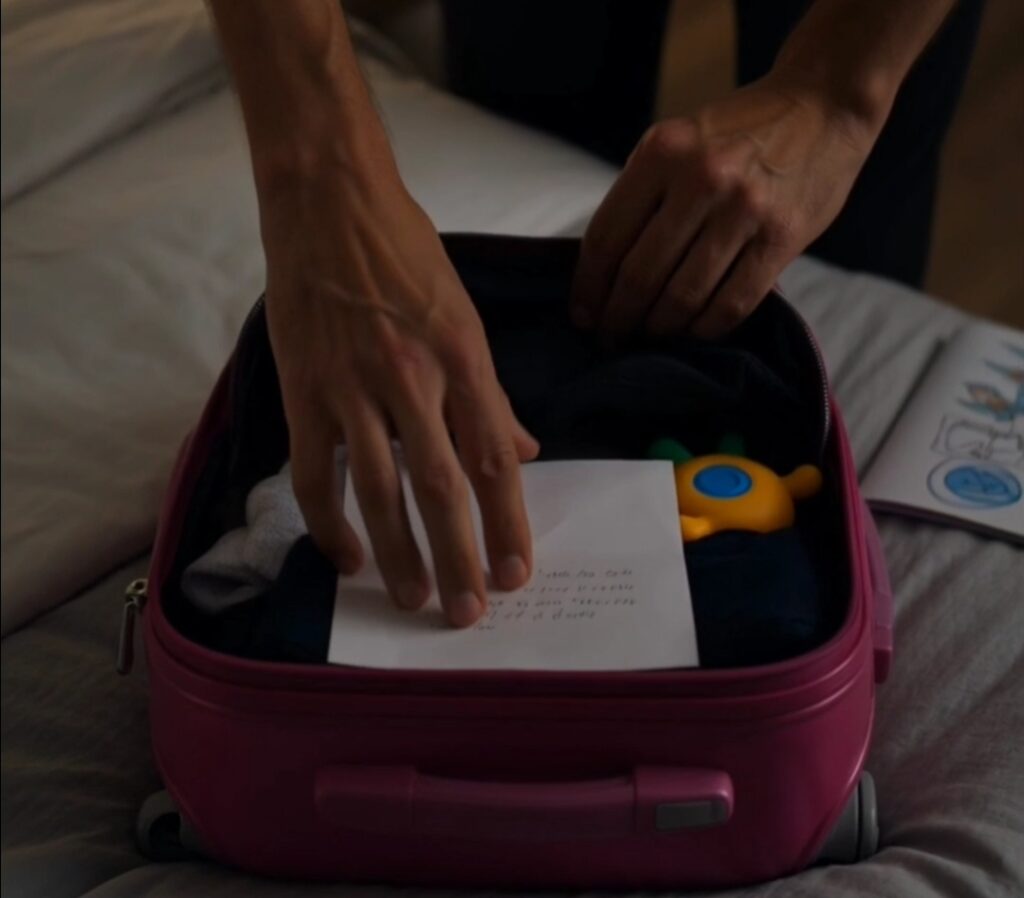
Even now, I can still remember how ordinary it looked. Pink plastic corners. A zipper charm shaped like a star. A faint smell of sunscreen and lavender detergent. Nothing about it suggested it was carrying the truth that would fracture my life before morning.
At first, I found what any parent would expect: folded clothes, a damp bathing suit stuffed in a side pocket, one sandal with dried mud on the strap, a half-finished coloring book, a hairbrush still holding a few strands of soft brown hair.
Then, beneath the clothes, tucked inside a zippered divider, I found an envelope from a local clinic.
It had already been opened.
My name was nowhere on it.
Rachel’s was.
I stood there under the dim bedroom lamp, staring at the paper as a strange heat gathered behind my eyes. I read the notes once. Then again. Then a third time, slower, because my mind was trying to reject what my eyes had already understood.
Bruising.
Abrasion.
Upper thigh.
Inner arm.
Patient withdrawn during examination.
Mother informed.
Follow-up advised.
The room turned silent in that unnatural way silence does when the world has just shifted under your feet.
Rachel knew.
My wife knew our daughter had been hurt badly enough to be taken to a clinic. She had known there were visible injuries. She had signed the paperwork. And then she had said nothing to me.
Nothing.
Not when I asked how the week had gone.
Not when I noticed Sofia was quiet.
Not when our daughter recoiled from an ordinary gesture of affection.
There are moments when a man realizes that the story he has been telling himself about his life is not merely incomplete — it is false.
I had told myself Rachel was polished, structured, emotionally reserved. I had called it maturity. I had excused her mother’s coldness as old-fashioned standards, as a generational difference, as the kind of hard-edged refinement some families mistake for strength.
But there is a kind of order that is not peace.
There is a kind of control that is not wisdom.
And there is a kind of silence that does not protect a family — it feeds the thing harming it.
I sat on the edge of the bed with that clinic report in my hands and felt something inside me become very clear.
This was not about manners.
This was not about “teaching respect.”
This was not about one stern grandmother being too harsh.
This was about a child being shaped through fear and pain while the adults around her called it correction.
And it is a dangerous day when people start loving appearances more than innocence.
Chapter 3: The Woman in My Kitchen
I did not storm into the living room.
Anger was there, yes — hot and immediate — but it had already hardened into something steadier than rage. There are moments when shouting only relieves the guilty. Calmness, on the other hand, forces truth to stand in the light.
So I walked into the kitchen, laid the clinic notes flat on the granite island, and waited.
Rachel came in a few minutes later, still holding her phone. She looked elegant, composed, untouched by the storm that had just split my chest open. Then she saw the paper.
She stopped.
And in that pause, I understood something I wish I had never needed to learn: innocence explains, but guilt calculates.
Rachel didn’t ask where I found it.
She didn’t look shocked.
She didn’t say, “I meant to tell you.”
She just looked at me and realized the silence had expired.
“What is this?” I asked.
Her face didn’t crumble. It chilled.
“She needed structure,” she said.
Not apology. Explanation.
Not grief. Strategy.
I asked her if Sofia’s grandmother had done this.
Rachel crossed her arms and spoke with a precision so cold it felt rehearsed. She talked about family standards. About behavioral lapses. About how Sofia had become “too emotional,” “too impulsive,” “too wild.” She said her mother believed girls needed discipline early so they wouldn’t grow into weak women later.
Weak women.
I remember staring at her, trying to find any trace of the person I thought I married.
Instead, I found someone who had mistaken tenderness for a defect.
Someone who looked at a seven-year-old child and saw something to be managed instead of someone to be protected.
And this is what pride does when it is left unchallenged for too long: it begins to worship control. It would rather wound the heart than surrender the illusion of order.
Rachel kept talking, but every sentence only stripped away another layer of pretense. She spoke of legacy. Of reputation. Of correction. Of composure. She spoke as though our daughter’s spirit were an inconvenience that needed editing.
I thought of Sofia’s flinch in the driveway.
Her careful smile.
Her whispered “It was fine.”
A child had been taught that safety belonged to the people hurting her.
That is how damage travels through generations: not only through cruelty, but through the elegant language that excuses it.
I looked at my wife and realized love without courage becomes complicity.
And I refused to be complicit.
Epilogue: The Night I Chose My Daughter
I packed Sofia’s bag before midnight.
Only the essentials. Pajamas. Toothbrush. Her rabbit with the bent ear. Two changes of clothes. The coloring book from the suitcase. I moved quietly, but not secretly. I was beyond secrecy by then.
When I entered Sofia’s room, she woke the moment I touched her shoulder.
I whispered, “We’re going for a little drive.”
She didn’t ask why.
That broke me more than tears would have.
Children should ask questions when they are woken in the middle of the night. They should be confused, sleepy, dramatic, resistant. They should not immediately understand that leaving quickly might be the safest thing.
She slid her hand into mine without a word.
In the car, the streetlights moved across her face in pale stripes. She leaned against the seat with her rabbit pressed to her chest. I kept one hand on the wheel and the other open between us until she reached for it.
And when she did, her grip said everything her mouth couldn’t.
Fear.
Relief.
Exhaustion.
Trust hanging by a thread, but still alive.
By 9:00 the next morning, I was not at home arguing over philosophies of parenting. I was sitting in a sterile office across from a child safety investigator while clinic notes were read aloud in a steady, professional voice.
The investigator did not dramatize anything. She didn’t need to. Truth is often most terrifying when spoken plainly.
She asked careful questions. I answered every one. She made notes. Her pen moved with quiet certainty, and I knew my old life was ending line by line.
What followed was not graceful.
There were calls. Interviews. Legal steps. Statements I never imagined I would give. People who had once smiled at us as a family now choosing sides based on comfort, status, and denial. Rachel’s mother called me unstable. Rachel called me extreme. They both acted as though my refusal to tolerate harm was the real disruption.
That is another ugly truth of this world: when you break a pattern of wrongdoing, the pattern often calls you the problem.
But peace built on a child’s fear is not peace.
A family image purchased with silence is not love.
And loyalty that protects abusers is not virtue.
It took time for Sofia to return to herself.
Healing did not come all at once. It came in fragments. In the way she slowly stopped apologizing for spilled juice. In the way she started laughing loudly again. In the way she no longer froze when I reached toward her unexpectedly. In the way she began, little by little, to believe that home was not a place where she had to earn gentleness.
I lost my marriage.
I lost the illusion of a polished, successful, intact family.
I lost the comfort of pretending that decent furniture, good income, and respectable appearances can save a house from rot in its foundation.
But I kept my daughter.
And in the end, that was the only thing worth fighting for.
Now, when I open the front door, Sofia runs toward me again.
Not cautiously. Not carefully. Not like someone waiting to be corrected.
She runs like a child.
And that sound — those unrestrained footsteps crashing through the hallway — is holier to me than all the false peace I used to protect.
Because dignity is not something you negotiate with cruelty.
It is something you defend.
And sometimes saving your child means letting the life you built collapse, so the life that truly matters can begin.
