

I didn’t grow up with a complete picture of family.
My earliest memories are scattered—soft, incomplete. A voice I can’t fully place. A face I can’t clearly remember. By the time I was old enough to ask questions, my father was already gone from our lives.
My mother, Elena, and I moved to a small town called San Aurelio—a place surrounded by rice fields and constant wind that carried dust into everything. Life there was simple, but never easy.
When I was four, she remarried.
His name was Mateo Rivas.
He didn’t arrive with much—no wealth, no education, no grand promises. Just a tired body, sunburned skin, and hands that looked like they had spent a lifetime holding weight.
At first, I kept my distance.
He left early every morning, long before the sun settled over the fields, and returned late, covered in dust and the smell of cement. He didn’t talk much. Didn’t try to force anything.
But he noticed everything.
When my bicycle chain snapped, it was fixed by morning.
When my shoes tore, they were quietly stitched while I slept.
When I broke something out of carelessness, he never raised his voice—he simply repaired it.
And when I got into trouble at school—
he showed up.
I still remember that afternoon.
I had been pushed around by a group of older boys. I didn’t fight back. I didn’t know how.
He came to get me on his old bicycle.
We rode home in silence for a while.
Then he said, calmly:
“I won’t ask you to call me father.”
A pause.
“But I will always be here when you need one.”
That was the moment something shifted.
I don’t remember deciding it.
But from then on—
he was my dad.
Our life didn’t change much after that.
Still small. Still difficult.
But steady.
Every evening, no matter how exhausted he was, he would sit down and ask:
“How was school?”
He didn’t understand most of what I was learning.
But he understood something more important.
“Education gives you choices,” he told me once. “Don’t waste that.”
We didn’t have much.
Some days, we barely had enough.
But when I passed the entrance exam to Central City University—
everything stopped.
My mother cried.
Not quietly.
Not briefly.
She held the acceptance letter like it might disappear.
Mateo didn’t say much.
He just nodded.
Then, a few days later—
his motorbike was gone.
I didn’t understand at first.
Until he handed me the money.
“It’s time for you to go,” he said.
I didn’t want to take it.
But he didn’t give me a choice.
In the city, everything felt bigger.
Faster.
Harder.
But he visited whenever he could.
Always the same way.
Sweaty from travel.
Wearing that same old cap.
Carrying food from home like it was treasure.
Rice.
Dried fish.
Peanuts.
Before leaving, he would always say the same thing:
“Study well.”
Once, after he left, I found a note inside the bag.
“I don’t understand what you’re learning,” it said. “But I’ll keep working so you can.”
I kept that note.
Through college.
Through sleepless nights and endless exams.
Through moments when I wanted to quit.
Years passed.
I graduated.
Then continued.
Master’s.
Then—
a PhD.
Each time I called home, I told him to rest.
To stop working so hard.
He would laugh it off.
“I’m raising a doctor,” he’d say. “That’s enough reason to keep going.”
By the time my defense day arrived—
his back was more bent.
His hands rougher.
But his eyes—
still the same.
He came wearing a borrowed suit.
It didn’t fit quite right.
The shoes were stiff, like he wasn’t used to them.
And the hat—
new.
Probably the newest thing he owned.
He sat at the very back of the room.
Straight.
Quiet.
Watching every word I said.
When it was over—
when the questions ended, and the room shifted into applause—
I felt relief.
But also something else.
I looked at him.
And he nodded once.
That was enough.
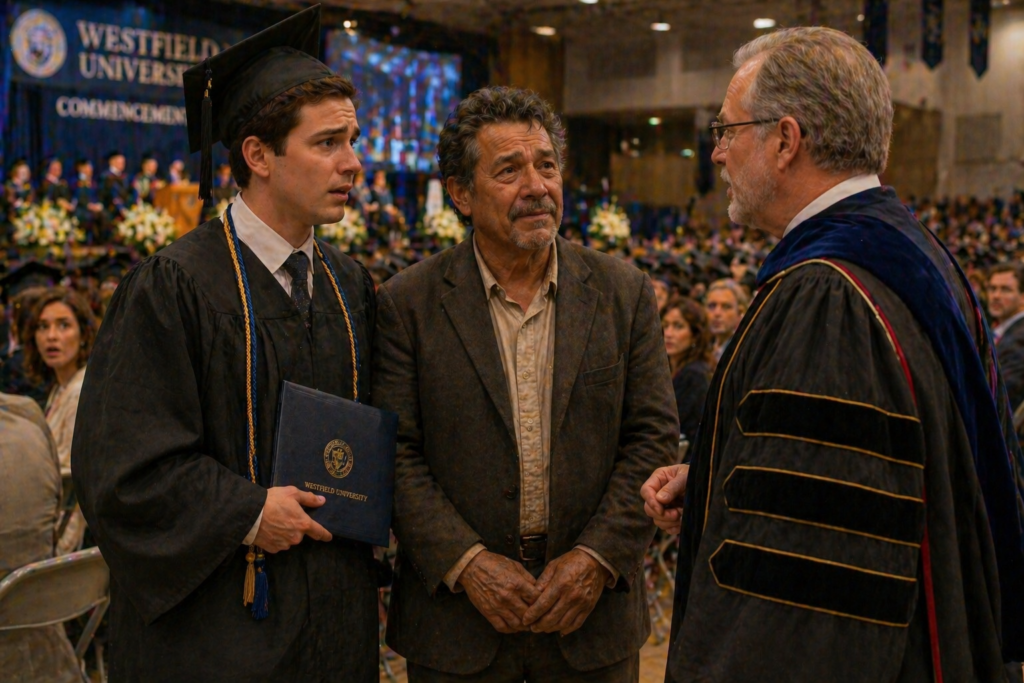
Afterward, my advisor, Professor Daniel Reyes, approached to congratulate me.
Then he turned to meet my family.
His expression was polite at first.
Professional.
Until he saw Mateo.
He stopped.
Looked again.
“…Mateo Rivas?” he asked slowly.
My dad blinked, surprised.
“Yes,” he answered.
The room grew quieter.
Professor Reyes stepped closer.
“I don’t believe this,” he said softly.
He turned to me.
“Do you know what this man did?”
I frowned.
“No,” I said.
The professor looked back at Mateo.
Then spoke—louder now, so others could hear.
“Twenty-five years ago, when I was a junior engineer… I made a mistake at a construction site.”
He paused.
“Something that could have cost lives.”
The room stilled.
“But he,” the professor said, nodding toward my dad, “stepped in and took responsibility.”
I felt my chest tighten.
“What do you mean?” I asked.
The professor exhaled.
“He said it was his fault. Protected me. I kept my job. My career continued.”
He looked directly at me.
“I wouldn’t be standing here today without him.”
Silence filled the room.
I turned to Mateo.
He looked… uncomfortable.
Like he didn’t want this being said.
“Why didn’t you ever tell me?” I asked.
He shrugged slightly.
“It was just work,” he said.
Just work.
That’s all it was to him.
But to me—
it changed everything.
Because in that moment, I realized—
he hadn’t just built buildings.
He hadn’t just worked for my education.
He had been shaping lives long before mine.
Quietly.
Without recognition.
Without expecting anything back.
I stepped toward him.
No hesitation this time.
And hugged him.
Tightly.
The room watched.
But it didn’t matter.
Because for the first time—
I understood fully.
He didn’t need a title.
He didn’t need recognition.
He didn’t need to be called anything.
But if anyone ever asked me who my father was—
I had an answer.
Clear.
Certain.
Unshakable.
