

Chapter 1: The Knock at the Door
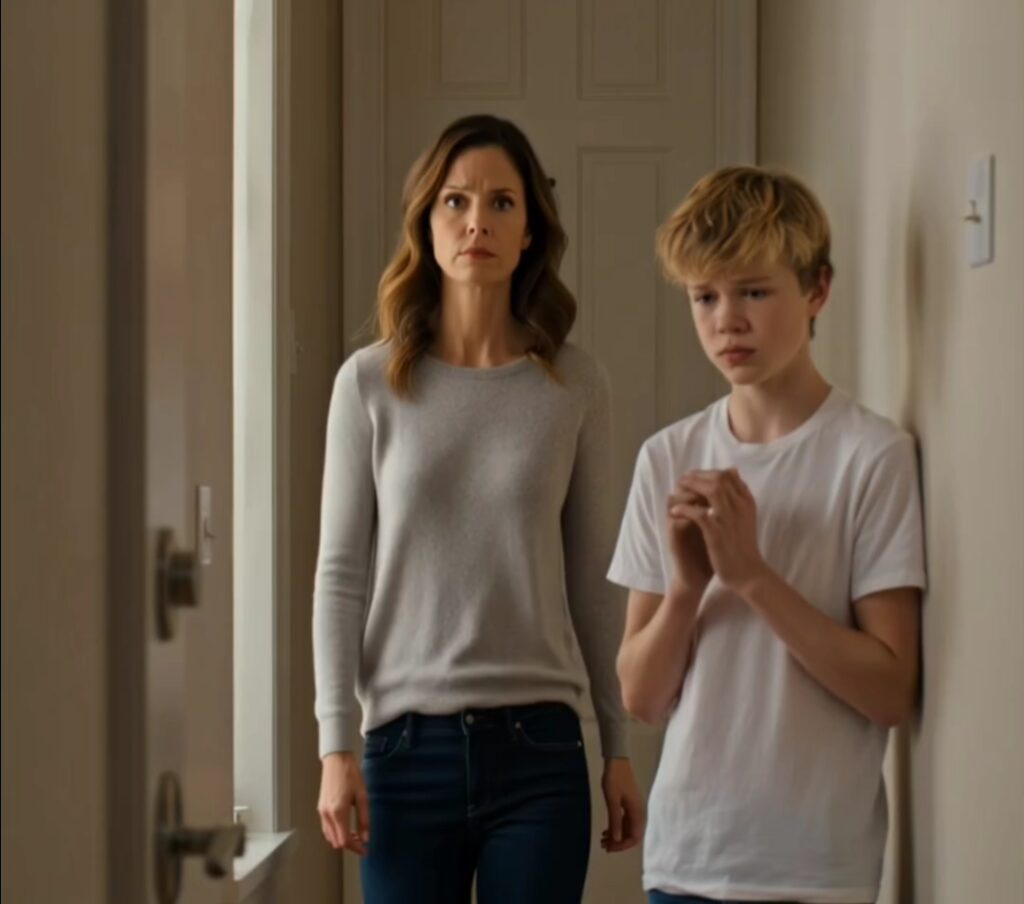
My heart slammed against my ribs so hard it hurt.
For one terrible second, all I could think was that something had gone wrong with the wheelchair. Maybe there had been some misunderstanding. Maybe someone thought David had stolen the money. Maybe selling the guitar had caused trouble we never saw coming.
David stood beside me in the hallway, pale and silent.
The taller officer looked from me to my son, but his face held no anger. If anything, there was something unreadable there. Calm. Controlled.
“Ma’am,” he said again, gentler this time, “please come outside. We’d like to speak with both of you.”
I swallowed hard and grabbed David’s hand without thinking. His fingers were cold.
We stepped out onto the porch.
And then I stopped.
Parked along the curb were not just the police cruiser, but a small crowd. Neighbors stood on their lawns pretending not to stare. Across the street, a woman held her phone at chest height like she was trying to record without being obvious. Near the sidewalk stood Emily, sitting in her brand-new wheelchair, her mother beside her with tears already in her eyes.
I looked at the officers in confusion.
The shorter one smiled.
“That,” he said, nodding toward the street, “is what this is about.”
I blinked. “I don’t understand.”
Emily’s mother stepped forward first.
Her voice trembled as she spoke. “I’m sorry if this frightened you. I tried to tell them not to scare you like this, but…” She laughed through tears. “They said they had a plan.”
David looked completely lost. “Mrs. Carter?”
Before she could answer, another car pulled up behind the cruiser. Then another.
One was from the local news station.
My stomach dropped again, though this time from shock rather than fear.
The taller officer turned to David. “Son, what you did for your classmate reached more people than you realize.”
David frowned. “I just bought her a wheelchair.”
The officer’s expression softened. “Exactly.”
Chapter 2: What Kindness Can Set in Motion
Emily’s mother wiped her eyes.
“Yesterday, after David brought Emily the wheelchair, she came home crying,” she said. “Not because she was upset. Because for the first time in months, moving didn’t hurt. For the first time in a long time, she felt like somebody saw her.”
Emily looked down, embarrassed, but she was smiling.
Her mother continued. “I posted about it online last night. I wanted friends and family to know what your son had done. I wrote that he sold something precious to help my daughter. I thought maybe a few people would read it.”
One of the officers let out a quiet laugh. “A lot more than a few did.”
The shorter officer pulled out his phone. “By midnight, the post had been shared thousands of times. By morning, local businesses were calling the station asking how they could help. The school principal called. A music shop owner called. A veterans’ group called. Even our chief saw it.”
I stared at them, trying to catch up.
Then the taller officer looked at David again.
“The reason we came,” he said, “is because sometimes people need to be publicly reminded that goodness still exists.”
David shifted uncomfortably. “I didn’t do it for attention.”
“I know,” the officer said. “That’s why it matters.”
There is a kind of goodness that performs itself loudly, always hoping to be seen. And then there is the quieter kind, the kind that gives up something loved simply because another person is hurting. One wants applause. The other simply answers need.
The second kind is rarer. And when it appears in a thirteen-year-old boy, it has a way of waking people up.
Chapter 3: The Surprise
The music shop owner stepped out from the crowd carrying a black case.
“I believe this belongs with you,” he said, walking up our driveway.
David stared. “That’s not mine.”
“Not yet,” the man replied.
He opened the case.
Inside was a beautiful new guitar — better than the one David had sold.
My son’s mouth fell open.
The man smiled. “I heard what you did, and I tracked down the buyer of your old one. He agreed to sell it back, so that guitar is waiting at my store for you too. But this one? This one is a gift.”
David looked overwhelmed. “I can’t take that.”
“Yes, you can,” the man said. “Because generosity should not leave a person emptier than before. It should multiply.”
David’s eyes filled with tears so fast that he turned his face away.
But the surprises were not over.
Emily’s mother reached into her purse and handed me an envelope. “People have been donating since early this morning,” she said. “For Emily’s therapy. For transportation. For medical costs.”
I opened it with shaking fingers.
Inside was a printed total from an online fundraiser.
It was enough not only to cover therapy for months, but to repair parts of the Carter home that Emily’s mother had quietly been struggling to adapt for wheelchair access.
I pressed my hand over my mouth.
Emily began crying again, and this time I did too.
Chapter 4: What We Teach Without Words
Later that afternoon, after the news cameras left and the neighbors finally drifted back inside, the house grew quiet again.
David sat at the kitchen table with the new guitar across his lap, though he hadn’t played a note yet.
I made tea neither of us drank.
Finally, I sat beside him and asked, “Why didn’t you tell me first?”
He stared at the strings. “Because if I asked, I was afraid you’d say no.”
“Why?”
He shrugged, but I could see he was choosing his words carefully.
“Because grown-ups worry about practical things,” he said. “Money. Timing. Whether something makes sense. Emily needed it now.”
His words pierced me a little, not because they were cruel, but because they were honest.
Children are always learning from us. But sometimes, if we’re humble enough, they become our teachers too.
I touched his shoulder. “Next time, tell me. Not so I can stop you. So I can stand with you.”
He looked up then, his eyes red but peaceful. “You’re not mad?”
“Mad?” I said, pulling him into a hug. “David, you gave away something you loved because someone else needed dignity more than you needed possession. I could never be mad at that.”
He buried his face into my shoulder, and for a moment he was still my little boy again.
Epilogue: The Echo of One Good Choice
That evening, Emily sent us a photo from outside. She was in her new wheelchair, smiling in the sunlight.
Below it, she wrote only one sentence:
I forgot what freedom felt like.
I sat staring at those words for a long time.
In this world, people often chase importance in loud ways. They want to be noticed, praised, remembered. But the truest weight a life can carry is not in being seen by many. It is in seeing one person clearly enough to help.
My son had not changed the whole world.
But he had changed Emily’s world.
And somehow, that had rippled outward — into neighbors, officers, strangers, business owners, and hearts that had grown tired and cynical.
That is how light works.
Not all at once. Not everywhere. But enough to prove the darkness is never final.
That night, I heard guitar music coming softly from David’s room.
Not loud. Not showy.
Just steady. Gentle. Full of feeling.
And as I stood in the hallway listening, I realized something I would never forget:
I thought I was raising a boy.
But that day, on my front porch, I saw the beginning of a man.
