

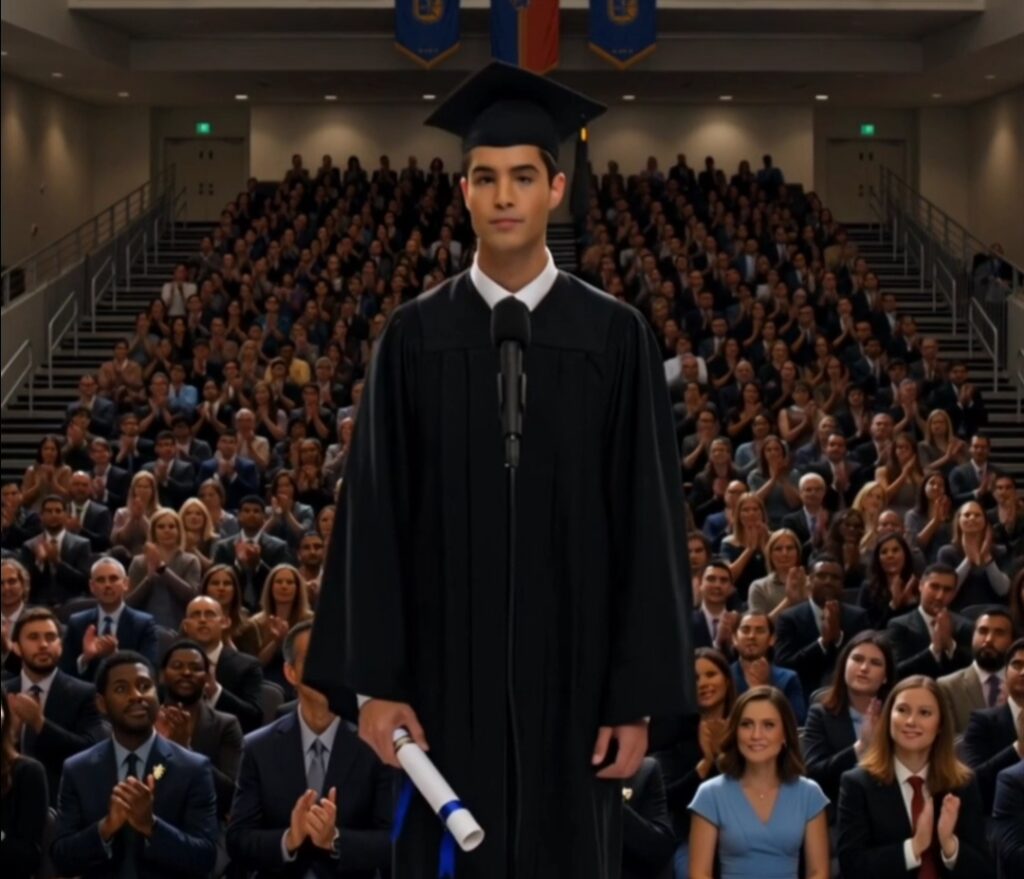
Chapter 1: The Man Who Returned for Applause
The auditorium held that strange kind of joy that only graduation days carry—the kind stitched together from sacrifice, old disappointments, and prayers people were almost too tired to keep making.
Parents leaned forward with phones in shaking hands. Professors smiled with professional pride. The air buzzed with music, camera flashes, and the rustle of expensive programs.
And there, three rows to my left, sat Warren.
My ex-husband had aged well in the shallow, visible ways that impress strangers. Silver at the temples. Tailored suit. Expensive watch catching the light every time he moved his wrist. He looked like a man who had spent twenty-five years protecting himself from inconvenience.
He also looked proud.
That was the part that made my stomach turn.
He sat there with the posture of a father arriving to collect credit. As if abandonment had an expiration date. As if the body he once rejected had become acceptable now that it moved in ways he could respect.
My son—my beautiful, stubborn, brilliant son—stood at the side of the stage waiting for his name to be called. His shoulders were broad now. His steps were steady. The cane had been gone for years, though I still sometimes imagined hearing its soft tap in hallways when I was tired enough to remember the old seasons too vividly.
He turned his head slightly and found me in the crowd.
I gave him the smallest nod.
Not because he needed courage.
Because sometimes love is simply saying, I’m here. I’m still here. I never left.
Then his name was announced, and the room erupted.
He crossed the stage with the kind of calm strength that doesn’t come from talent alone. It comes from suffering carried without surrender. It comes from being told “limited” so many times that the word loses its authority.
He accepted his diploma. The dean smiled. People clapped.
Then he stepped toward the microphone reserved for the student address.
And instead of facing the audience first, he turned and looked directly at Warren.
“Father,” he said, his voice clear enough to cut through every whisper in the room, “I rehearsed this for years.”
The applause faded into a silence so complete I could hear someone in the back set down a program.
Warren’s smile froze.
Chapter 2: The Speech No One Expected
“When I was born,” my son said, “a doctor told my parents I would spend my life in a wheelchair. My mother heard that and stayed. My father heard that and left.”
A ripple moved through the crowd.
No dramatics. No raised voice. Just truth, placed carefully in the center of the room where nobody could step around it.
“My mother was there for every surgery, every setback, every form, every infection, every night when pain made me mean and fear made me quiet. She learned words she never wanted to learn. She fought battles she never trained for. And she did it without once making me feel like I had ruined her life.”
I felt my throat tighten so hard it hurt.
He continued, his expression calm.
“My father, on the other hand, made a different choice. He decided disability was too heavy, too inconvenient, too ugly, too uncertain. And because he could not love a son who looked like hard work, he left before he learned my favorite color, before he heard my laugh, before he knew whether I’d love science or music or burnt toast or thunderstorms.”
No one moved.
Warren’s face began to change then. The confidence drained first. Then the color.
My son rested one hand lightly on the podium.
“I used to imagine this moment differently,” he said. “When I was younger, I thought if I ever stood in front of him—really stood—I would want revenge. I thought success would feel like a weapon. I thought I’d want him to hurt the way we hurt.”
He paused.
“But pain teaches you strange things when you survive it long enough. It teaches you that bitterness can chain you to the very people who failed you. It teaches you that not every wound should become a personality. And it teaches you that the opposite of abandonment is not revenge. It is faithfulness.”
He turned then and looked at me.
“My mother taught me that.”
I was crying openly by then, no grace left in it.
The woman beside me reached for my hand without asking.
Chapter 3: The Lesson Fate Delivered
Then my son reached into the inside pocket of his gown and unfolded a single sheet of paper.
“A month ago,” he said, “I matched into my residency program.”
The room broke into applause again, but he lifted a hand gently, asking for one more moment.
“It’s in neurological rehabilitation.”
A few professors nodded, already understanding the poetry of it.
“I chose it because I know what it means when the world reduces a human life to a prognosis. I know what happens when people hear a diagnosis and decide your story is over before it starts. I know how dangerous low expectations can be when spoken with professional voices.”
He looked again at Warren.
“And I know what it costs a child when a parent mistakes difficulty for worthlessness.”
Warren looked down now.
Not at the stage.
At his own hands.
“I invited my father here today for one reason,” my son said. “Not so he could celebrate me. Not so he could return now that walking makes me easier to admire. I invited him because I wanted him to witness something with his own eyes.”
His next words landed like a final bell.
“You did not leave because I was weak. You left because you were.”
A gasp moved across the hall.
Warren flinched as if struck.
My son did not smile. He did not sneer. He did something far worse for a man like Warren.
He told the truth without hatred.
“And here is the lesson,” he said. “The child you abandoned did not become extraordinary because you left. He became strong because someone stayed. So if you feel shame today, do not confuse it with injustice. It is simply the bill for a debt you avoided for twenty-five years.”
No one clapped this time.
No one dared.
Epilogue: What Remained After the Fall
Then my son folded the page, set it aside, and softened.
“I do not say this to humiliate you,” he said. “I say it because truth is the only mercy left between us. I have spent too many years healing to keep pretending your absence was a mystery. It was a decision.”
Warren’s eyes were wet now. Whether from regret, humiliation, or wounded pride, I could not tell. Maybe it did not matter.
“I forgive you,” my son said. “But forgiveness is not the same as restoration. You are not my father because you share my blood. You are a man who left. My parent is the woman sitting in the third row wearing blue, who worked with tired hands and an unbroken heart.”
The entire auditorium turned toward me.
I wanted to disappear and collapse at the same time.
My son smiled then—the small, tired, beautiful smile I had known since he was little.
“Everything good in me grew in the soil of her sacrifice. So this diploma, this white coat, this future—none of it belongs to abandonment. It belongs to love that stayed.”
The room rose to its feet.
Not politely.
Not gradually.
All at once.
The applause thundered so hard it felt like weather.
Warren remained seated.
Alone in the middle of standing people.
And in that moment, fate did hand him a lesson—not by destroying him, but by forcing him to watch the life he rejected rise without him.
Later, outside beneath the bright afternoon sun, my son found me near the steps and wrapped me in his arms.
“You okay?” he whispered.
I laughed through tears. “Ask me when I can breathe again.”
He smiled.
Behind us, the crowd spilled out in waves. Somewhere in that crowd, Warren disappeared without speaking to either of us.
And this time, his leaving did not feel like a wound.
It felt like a door closing on a room we had already outgrown.
