

PART 1: The Bag of Rice
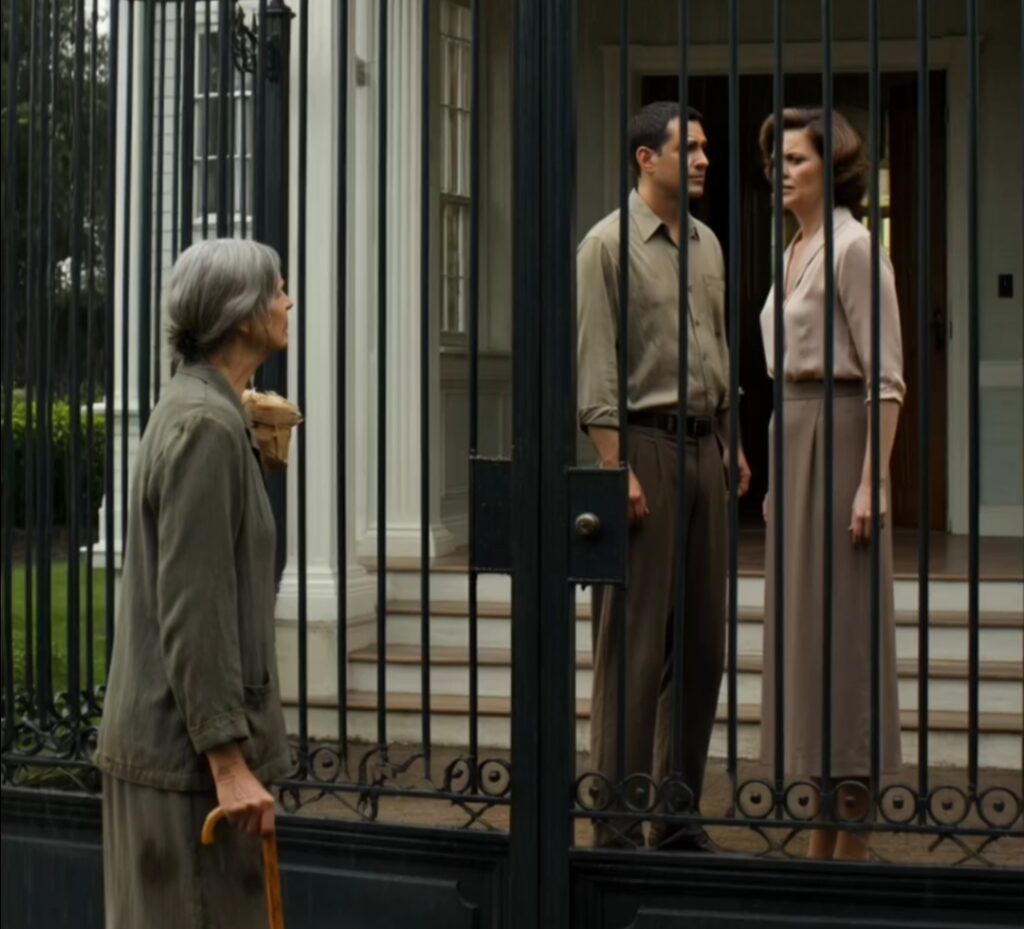
At seventy years old, Doña Rosa never imagined she would stand outside her own son’s house, asking for help like a stranger. The evening sky over San Miguel de las Flores darkened with heavy clouds, and the first drops of rain began to fall, mixing with the tears she refused to let escape.
With her worn shawl wrapped tightly around her shoulders and a cane supporting her trembling steps, Rosa moved slowly down the dusty road. A small cloth bag hung from her arm—inside, only a few documents, an expired ID, and a handful of coins. She hadn’t eaten properly in nearly two days, but hunger wasn’t what hurt most. It was the decision she had finally made.
To ask her son for help.
Luis was no longer the boy she raised in the fields. He now owned a successful hardware store, drove a polished truck, and lived behind tall gates with his wife, Verónica. Rosa had heard how things had changed. She had also felt it.
Still, she told herself she wouldn’t beg. Just a small loan. Just enough for food. She would repay it somehow.
When she reached the house, the gate towered over her like a barrier between two lives. She hesitated, then rang the bell with unsteady fingers.
After a long pause, Verónica appeared, perfectly dressed, her expression cold and distant.
“What do you need?” she asked flatly.
Rosa forced a gentle smile. “I came to see Luis… I just need a small favor.”
Verónica studied her from head to toe before calling inside. Moments later, Luis stepped out, phone still in his hand, impatience already on his face.
“What’s wrong, Mom? I’m busy.”
Rosa swallowed her pride. “There’s nothing left at home. I was hoping you could lend me a little money. Just for food. I’ll pay you back.”
Luis hesitated, glancing quickly at his wife. “I don’t have any cash right now. Everything’s tied up in the business.”
“Even a little,” Rosa whispered. “I haven’t eaten in days.”
Verónica sighed sharply. “We’re not a bank.”
The words landed harder than the rain now falling steadily around them.
Luis disappeared inside for a moment, then returned holding a small bag of rice.
“Take this, Mom. It’s not money, but it’ll help.”
Before Rosa could say anything more, Verónica opened the gate just enough and nudged her back outside.
“You should go before the rain gets worse.”
Rosa clutched the bag tightly, murmured a soft thank you, and turned away. Behind her, the gate slammed shut—loud, final, echoing deeper than any insult.
The walk home felt longer. The rain soaked her clothes, mud clung to her shoes, and yet she kept going, holding onto one thought.
He gave me something.
Back in her small home, she placed the bag of rice on the table. Her hands trembled—not from cold, but from exhaustion.
She opened the bag.
And paused.
Something inside didn’t feel like rice.
Carefully, she reached in and pulled out a sealed envelope.
Her breath caught.
Slowly, she opened it.
Inside was a stack of bills—and a letter.
Thirty thousand pesos.
Her hands shook as she unfolded the paper.
Luis had written it.
PART 2: The Truth Inside the Envelope
The words blurred at first as tears filled Rosa’s eyes. She wiped them away carefully and began to read.
Luis apologized.
He admitted he had lied—that he did have money, but couldn’t give it openly. He confessed that Verónica would have caused a scene if she saw him helping her. He wrote that he still remembered everything she had done for him, every sacrifice, every hungry night she endured so he could eat.
“I love you, Mom,” the letter said. “I just don’t know how to help without breaking my home.”
Rosa sat down slowly, the letter trembling in her hands.
She didn’t cry because of the money.
She cried because of the truth.
Because love was still there—but hidden. Silenced. Afraid.
The next morning, Rosa went to the market. For the first time in days, she bought real food—beans, eggs, oil, coffee. The simple act of cooking again filled her small home with warmth. The smell of rice steaming on the stove brought a quiet sense of life back into the space.
But while Rosa found a moment of peace, across town, Luis’s life was beginning to unravel.
Verónica noticed the missing money almost immediately.
“Where is it?” she demanded, holding the ledger. “Thirty thousand pesos doesn’t just disappear.”
Luis tried to remain calm. “I used it.”
“For what?” she pressed.
He hesitated—and that hesitation said everything.
“You gave it to her, didn’t you?” Verónica snapped. “To your mother.”
Luis stayed silent.
That was enough.
The argument exploded.
“You always choose her!” Verónica shouted. “We have a family here!”
“She’s my mother,” Luis shot back, frustration finally breaking through. “She needed help!”
“She’s not our responsibility!”
Their voices echoed through the house—until a smaller voice cut through the chaos.
“Why do you hate Grandma?”
Their daughter, Camila, stood in the doorway, tears in her eyes.
The question hit harder than anything else.
Silence followed.
Not the kind that calms—but the kind that forces truth to surface.
Days later, Luis drove to Rosa’s house, his heart heavy with guilt. He hadn’t heard from her. Something felt wrong.
When he entered, the door creaked open too easily.
“Mom?” he called.
No answer.
He found her collapsed near the table.
The same table where the rice had once sat.
At the clinic, Luis sat beside her bed, his hands shaking. The doctor spoke of exhaustion, dehydration, and weakness.
“Another day or two,” the doctor said quietly, “and it could have been worse.”
Luis looked at his mother, fragile and pale, and felt something inside him break completely.
When Rosa finally opened her eyes, he leaned forward immediately.
“I’m sorry,” he whispered. “I should have been there. I shouldn’t have hidden it.”
Rosa looked at him gently.
“The money helped,” she said softly. “But hiding love… hurts more than hunger.”
PART 3: When Love Is No Longer Hidden
That moment changed everything.
Luis returned home, but he was no longer the same man who had quietly slipped money into a bag of rice. The fear that once controlled him had been replaced by something stronger—clarity.
That evening, he faced Verónica again.
“I’m done hiding,” he said firmly. “She’s my mother. Helping her is not a mistake.”
Verónica crossed her arms, defensive. “And what about this family?”
“This family,” Luis replied, steady and calm, “should be built on respect—not control.”
The words hung in the air.
For the first time, he didn’t back down.
Days passed. The tension didn’t disappear overnight, but something shifted. Verónica, shaken by Camila’s question and Luis’s resolve, began to see things differently.
Reluctantly at first, she agreed to visit Rosa.
The ranch felt smaller than she expected. Simpler. Quieter.
Rosa greeted her with the same kindness she always had—no bitterness, no anger.
That was what unsettled Verónica the most.
Over time, those visits became less forced. Conversations grew longer. Understanding, though slow, began to form.
Luis didn’t stop there.
He repaired Rosa’s home, filled her pantry, and most importantly, showed up—not with hidden gestures, but with open care. Meals were shared. Stories were told. Laughter, once absent, began to return.
In the town, people started talking—not out of gossip, but admiration.
A son who learned that love must be visible.
A family that chose to rebuild instead of break.
And Rosa?
She spent her afternoons sitting outside her home, sunlight warming her face, a simple pot of rice simmering gently inside.
She would watch the road, knowing her son would come—not in secret, not in fear, but openly.
Because that small bag of rice had carried more than food.
It carried a truth.
That love, even when delayed… even when imperfect… can still heal.
As long as it is no longer hidden.
