

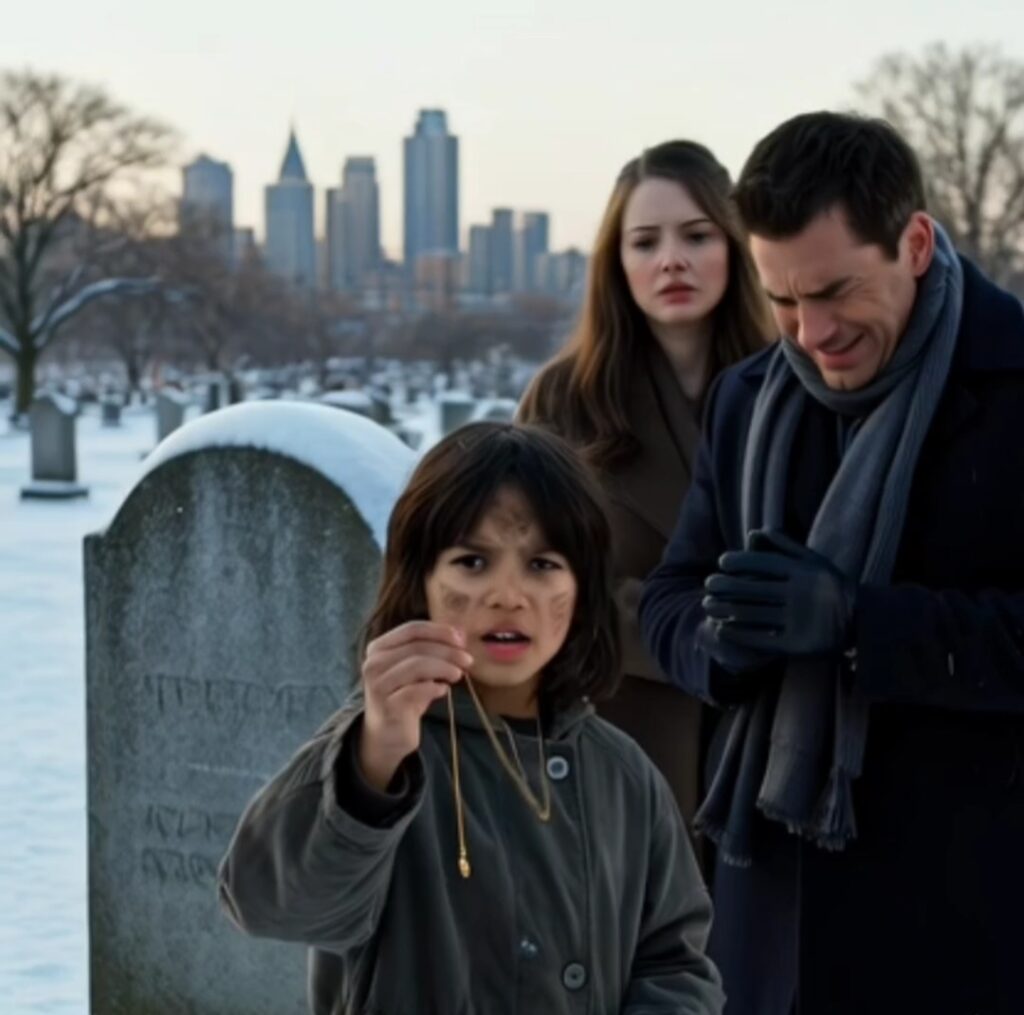
The necklace glimmered beneath the pale winter sun, swinging lightly against the fragile collarbone of a girl who looked far too small for her eight years.
Michael Carter felt the earth shift beneath him. His throat tightened so sharply he could barely breathe, and he reached for the granite headstone to steady himself. It was cold—just as it had been every year since that terrible day. Every visit. Every bouquet laid beneath the carved name he could hardly bear to read aloud.
His wife, Rebecca, was still kneeling in front of the girl, unaware of the storm tearing through her husband. She saw something simpler: hollow cheeks, worn sneakers with torn laces, a trash bag filled with cans clutched like treasure. She saw hunger—and pride fighting not to beg.
“Where did you get that necklace?” Michael asked, his voice raw and uneven.
The girl instinctively covered the pendant with her small, dirt-smudged hand.
“It’s mine,” she said firmly. “I’ve had it since I was a baby. They said it was with me when I was found.”
Rebecca slowly stood. The world seemed to tilt. There, resting against the child’s chest, was a gold medallion engraved with two intertwined letters—A and C.
Those letters.
The same initials Rebecca’s mother-in-law had kissed before fastening the necklace around their newborn daughter’s neck. “It will protect her,” she had whispered. “It’s been in the Anderson family for generations.”
Rebecca’s breath trembled. She wanted to deny what she was seeing. To call it coincidence. A replica. Anything but this.
But gold doesn’t forget.
And neither does a mother’s heart.
“What’s your name?” Rebecca asked softly.
“Grace,” the girl answered, wary but steady. “My name’s Grace.”
Michael stepped closer, every movement careful, as if one wrong breath would shatter something sacred.
“You said someone found you,” he pressed gently. “Who?”
Grace shrugged. “Miss Linda. She works at the shelter now. She said I was left outside St. Matthew’s Church wrapped in a blanket. Just me and this necklace.”
Rebecca covered her mouth to hold back a sob. Eight years. Eight endless years of believing their daughter, Abigail, had died in that hospital fire. Eight years of visiting a grave they never opened. Eight years of wondering if they had failed her.
Grace’s eyes darted between them. She sensed the intensity—too heavy, too bright.
“I need to go,” she said, stepping back. “Miss Linda doesn’t like me being late.”
“Please,” Rebecca whispered, reaching out without thinking. “Just a few minutes.”
Michael forced himself to breathe slowly. “Are you hungry?” he asked. “There’s a diner across the street. Pancakes. Hot chocolate. No strings attached.”
Grace hesitated. She had learned that kindness usually came with conditions. But Rebecca’s tears weren’t fake. And Michael looked less like a threat and more like a man barely standing.
“What do you want from me?” Grace asked bluntly.
Rebecca swallowed. “That necklace belonged to our daughter,” she said honestly. “Seeing it on you… it feels impossible. We just want to understand. We won’t take it. I promise.”
Grace tightened her grip on the pendant. It was the only thing that had never been taken from her.
Her gaze drifted to the headstone behind them.
She read the name slowly: “Abigail Anderson. Our light. Forever loved.”
Silence thickened.
Michael felt something in his chest tear open. The dates on the stone—Abigail would have been exactly Grace’s age.
“Grace,” he said carefully, “can we see Miss Linda together?”
Suspicion flickered in her eyes. “Why?”
“Because if there’s even the smallest chance…” Rebecca’s voice broke. “We need to know.”
After a long pause, Grace nodded once.
The shelter was only three blocks away. Grace walked slightly ahead, as if leading them into her world. The building smelled of bleach and overcooked vegetables. The front desk clerk looked startled when Michael and Rebecca stepped inside—tailored coats, polished shoes, faces pale with urgency.
“Miss Linda?” Grace called.
A woman in her forties emerged from an office. She froze when she saw the couple.
“Can I help you?”
Michael spoke first. “We believe Grace may be our daughter.”
The words felt impossible and fragile in the air.
Miss Linda’s expression shifted from confusion to caution. “That’s a serious claim.”
Rebecca removed a photo from her purse—a picture she carried every day. A newborn baby wrapped in a pink blanket. Around her neck: the same medallion.
Miss Linda inhaled sharply.
“She was found the night of the hospital fire,” she said slowly. “No identification. Authorities assumed her family didn’t survive. We tried for months to trace records, but the system was chaos back then.”
Michael’s knees nearly buckled.
“There was no body,” Rebecca whispered. “They told us she died in the smoke.”
Grace stood silent, eyes wide. “You think I’m… yours?”
Rebecca knelt carefully, keeping distance. “We don’t know yet. But we hope. More than anything.”
Grace looked at them as if trying to recognize something. A smile. A familiar expression.
“You both cry the same,” she said quietly.
Michael laughed through tears.
A DNA test was arranged that very afternoon. The wait felt longer than the eight years before it. Rebecca barely slept. Michael paced their mansion like a prisoner awaiting judgment.
Three days later, the call came.
A match.
One hundred percent.
Grace—small, guarded, fierce Grace—was Abigail Anderson.
Rebecca collapsed into Michael’s arms, sobbing with relief so overwhelming it felt painful. Michael wept openly for the first time since the fire.
When they returned to the shelter, Grace was sitting on the steps, chin lifted stubbornly.
“So?” she asked.
Michael knelt in front of her. “You’re our daughter.”
Grace didn’t react immediately. She stared at him, searching for lies.
Rebecca stepped closer. “We never stopped loving you. Not for a second.”
Grace’s lips trembled. “Why didn’t you come?”
The question pierced deeper than any accusation.
“We thought you were gone,” Michael said, voice cracking. “We searched. We begged. But we were told there was nothing left to find.”
Grace’s shoulders began to shake. For years, she had built walls from survival. But children don’t stop needing their parents. They just learn not to ask.
Rebecca opened her arms slowly.
Grace hesitated only a heartbeat before stepping into them.
It wasn’t graceful. It wasn’t cinematic. It was messy and desperate and real. Grace clung to her mother as if afraid the truth might disappear.
Michael wrapped his arms around both of them, pressing his forehead against Grace’s hair.
“I’m sorry,” he whispered. “I’m so sorry.”
Life didn’t transform overnight. There were therapy sessions. Nightmares. Awkward dinners. Grace struggled to trust the silence of her new bedroom—too big, too quiet.
But she kept the necklace on.
And Michael kept his promise: he never removed the headstone. He replaced it with a memorial garden instead—a reminder of the years lost, and the miracle returned.
One spring afternoon, Grace stood between her parents in that garden.
“Did it really protect me?” she asked, touching the pendant.
Rebecca smiled through tears. “Maybe it didn’t protect you from everything.”
Michael squeezed her hand. “But it brought you back to us.”
Grace looked up at them, sunlight catching in her eyes.
“I guess it did its job,” she said.
And for the first time in eight years, the cemetery no longer felt like a place of endings.
It felt like the place where their family began again.
