

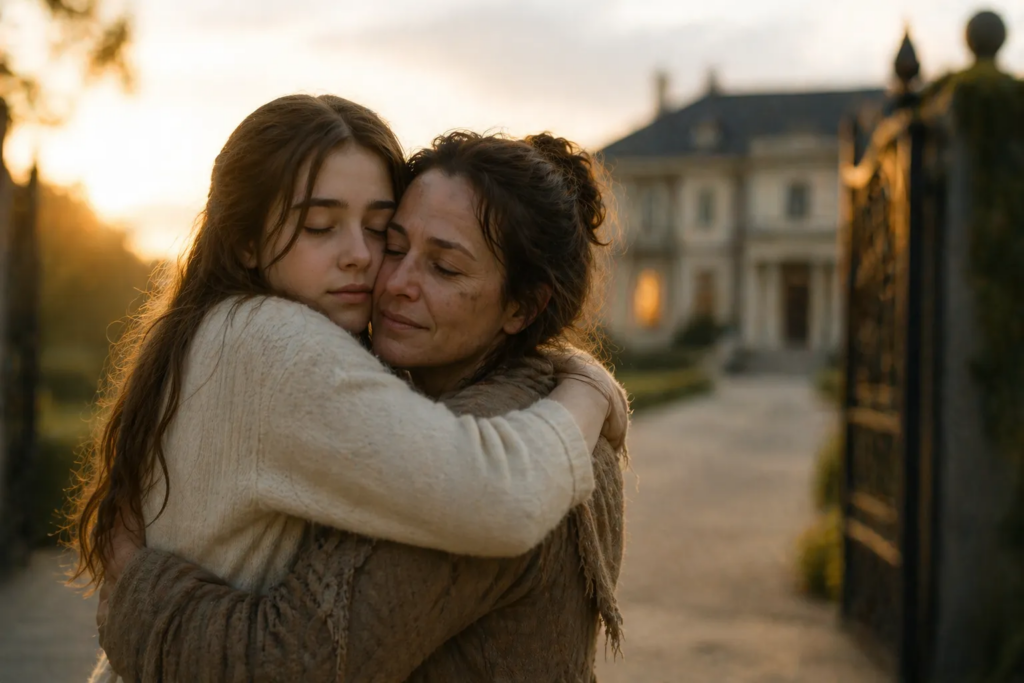
“Would you give up a life of wealth for a mother who has nothing… except the truth?”
The voice came from the shadows before anyone saw her.
“Clara… don’t forget who carried you.”
The group of students froze.
It was late afternoon on campus, the kind of golden hour where everything felt calm and predictable. Clara Whitmore stood near the old stone pillars with her friends, laughing about something trivial—until the voice cut through the moment like something out of place.
Then the woman stepped forward.
Her clothes were worn, layered unevenly, as if pulled together from whatever she could find. Her hair was tangled, her face thin but not empty—there was something disturbingly focused in her eyes.
Clara didn’t scream.
She didn’t step back.
Instead, she ran toward her.
“Clara! What are you doing?!” one of her friends shouted.
But Clara was already there, wrapping her arms around the woman as if she had been waiting for her.
The woman stiffened for a second… then slowly, carefully, returned the embrace.
“Clara!” another friend yelled. “That woman’s been following you for weeks! You told security about her!”
Clara pulled back slightly but didn’t let go.
“I just… missed her,” she said quietly.
Her friends stared at her like she had lost her mind.
But Clara’s heart was racing—not from fear, but from something she didn’t understand.
Because the woman hadn’t just called her name.
She had said it like it belonged to her.
The next morning, Clara went back alone.
She told no one. Not her friends, not the house staff, not even the woman she had called “Mother” her entire life.
She found the woman sitting behind the same pillars, wrapped in a worn coat despite the mild weather.
“You came,” the woman said, as if she had expected nothing less.
Clara hesitated, then sat down across from her.
“Why do you keep calling me that?” she asked. “Why do you act like you know me?”
The woman studied her face for a long moment.
Then she said, very quietly, “Because I do.”
Clara felt something tighten in her chest.
“That’s not possible,” she said.
The woman nodded slowly.
“That’s what they wanted you to believe.”
Silence stretched between them.
Then the woman took a breath.
“Seventeen years ago,” she began, “there was a fire at St. Mary’s Hospital.”
Clara frowned slightly. “I was born in London.”
“You were born in that hospital,” the woman continued, ignoring her. “I remember the smell of smoke before I even opened my eyes after the delivery. I remember the alarms. I remember the nurses running.”
Her voice didn’t shake. That was what made it worse.
“I had just given birth to a baby girl,” she said. “You.”
Clara felt her pulse quicken.
“No,” she said instinctively. “My mother—”
“Your mother was told her child had died,” the woman said sharply. “That’s the story, isn’t it?”
Clara went silent.
Because that was the story.
A complicated birth. A close call. A miracle recovery.
She had heard it her entire life.
The woman leaned forward slightly.
“But I never saw a body,” she said. “I saw something else.”
Clara didn’t want to ask.
But she did.
“What?”
“A woman,” she said. “Dressed in white. Not like a nurse. Like someone important. She walked past me carrying a bundle wrapped in cloth. Too carefully for it to be nothing.”
Clara’s breath slowed.
“I followed her,” the woman continued. “Not far. I was weak. But I saw enough.”
Her eyes locked onto Clara’s.
“A gold car,” she said. “Waiting behind the hospital. She got in. And then she was gone.”
The world around Clara felt distant, like the sound had been turned down.
“That doesn’t prove anything,” she said, though her voice lacked conviction.
The woman didn’t argue.
Instead, she said, “Check your right wrist.”
Clara froze.
“What?”
“A birthmark,” the woman said. “Shaped like a crescent. And a small mole behind your neck. Left side.”
Clara stared at her.
“How would you—”
“Check,” the woman repeated.
Slowly, almost mechanically, Clara turned her wrist over.
Her breath caught.
The mark was there.
Faint, but unmistakable.
She stood up abruptly.
“No,” she whispered. “No, this doesn’t mean—”
“Check your neck,” the woman said softly.
Clara didn’t want to.
But her hand moved anyway, reaching behind her neck.
Her fingers found it instantly.
A small raised mole.
Exactly where the woman had said.
Her vision blurred.
“That’s not possible,” she said again, but this time it sounded like a question.
The woman stood up slowly.
“They told me you died,” she said. “They buried an empty promise and called it closure.”
Clara shook her head, backing away.
“My mother would never—”
“Your mother,” the woman interrupted gently, “is not the woman who raised you.”
That evening, Clara didn’t go home right away.
She waited.
Across the street from her family’s estate, hidden behind a row of trees where the cameras couldn’t fully see her.
She had never done anything like this before.
But something inside her refused to let it go.
And then she saw it.
A black car pulling up quietly near the old bridge just outside the property.
Her mother—no, the woman she had always called her mother—stepped out.
Elegant. Composed. Perfect as always.
She carried a bag.
Clara’s heart pounded as she moved closer, staying out of sight.
A second figure emerged from the shadows.
The woman from the street.
They stood facing each other under the dim streetlight.
“You shouldn’t have come back,” the elegant woman said coldly.
The other woman didn’t respond.
Instead, she just looked at her.
The bag was thrown at her feet.
“Take it,” the elegant woman snapped. “And disappear. This is the last time I’ll be this generous.”
The bag opened slightly on impact.
Cash.
A lot of it.
“You can’t buy this,” the woman said quietly.
“I already did,” the elegant woman replied. “Seventeen years ago.”
Clara felt like the ground had shifted beneath her.
“You couldn’t have children,” the other woman said. “So you took mine.”
“I gave her a life,” the elegant woman shot back. “Education. Security. Everything you could never offer.”
“And the truth?” the woman asked.
Silence.
Then, slowly, she kicked the bag aside.
Bills scattered into the wind.
“I don’t want your money,” she said. “I want my daughter.”
Clara’s hands trembled.
Everything she had believed—every memory, every moment—suddenly felt unstable.
But she didn’t rush out.
She didn’t confront them.
Because Clara wasn’t just emotional.
She was smart.
Careful.
And she needed proof.
The next day, she acted like nothing had changed.
She smiled at breakfast. She answered questions. She played her role perfectly.
But inside, everything was different.
Later that afternoon, she returned to the pillars.
The woman was there.
Clara sat beside her quietly.
“I need something from you,” she said.
The woman nodded.
Clara hesitated for a moment.
Then she reached out, gently pulling a strand of hair from the woman’s shoulder.
The woman didn’t resist.
“You’re going to test it,” she said.
Clara looked at her, surprised.
“Yes,” she admitted.
“Good,” the woman replied. “You should.”
That night, Clara did something she had never done before.
She went into her mother’s private bathroom.
Her hands shook slightly as she picked up a brush from the counter.
Carefully, she removed a few strands.
That was all she needed.
Two days later, Clara sat in a private lab, her fingers tightly interlocked in her lap.
The technician avoided eye contact as he placed the envelope on the table.
“The results are conclusive,” he said.
Clara didn’t open it right away.
Her heart was beating too loudly.
“Just tell me,” she said.
There was a pause.
Then—
“They are biologically related,” he said. “You and the woman you brought in first.”
Clara’s world went completely silent.
“And the other sample?” she asked, her voice barely there.
“No genetic match.”
The words echoed.
No match.
Clara closed her eyes.
Everything she had ever known… was a lie.
But the truth?
The truth had been standing in the street all along, waiting for her to listen.
And now, she had to decide.
Would she stay in the life that was built on a lie…
or walk away with the woman who had nothing—
except the truth?
