

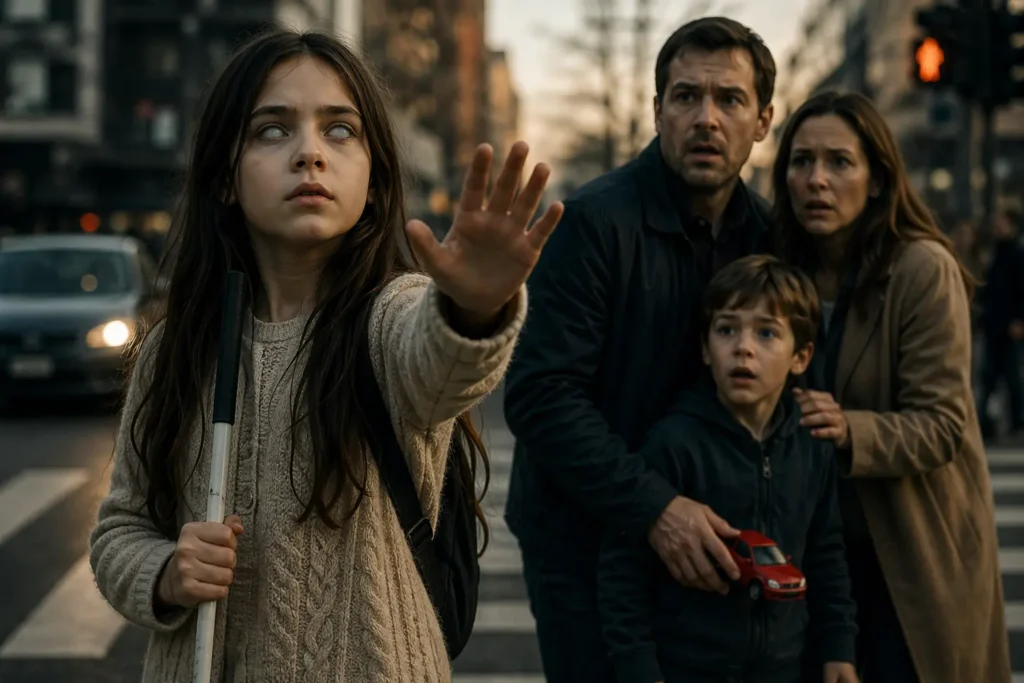
Emily Carter had never seen a single thing in her life, which was why her mother didn’t stop right away when she suddenly froze on the sidewalk.
They were walking down a busy street in a mid-sized city, the kind where traffic never fully settled and conversations blurred into a constant background noise. It was late afternoon. People were leaving work, crossing streets in loose crowds, checking their phones, calling out to each other. A bus hissed as it pulled away from the curb. Somewhere behind them, a dog barked sharply.
Emily moved with quiet confidence, her white cane tapping lightly ahead of her. She had memorized this route years ago—the uneven crack near the bakery, the slight slope before the crosswalk, the faint echo near the glass-fronted buildings. Her mother, Sarah, walked beside her, not holding her arm but always close enough to intervene if needed.
“Careful, the curb’s coming up,” Sarah said automatically.
Emily didn’t respond.
Her cane stopped mid-air.
“Emily?” Sarah asked.
Then, quietly, Emily said, “That boy shouldn’t be here today.”
Sarah blinked, distracted.
“What?”
Emily didn’t move. Her head tilted slightly, as if she were listening to something far more important than the rush of the street around them.
“That boy,” she repeated.
Sarah followed the direction Emily was facing. A family stood just a few feet ahead of them, waiting near the crosswalk. A man and a woman—mid-thirties, maybe—and a small boy between them. The boy was holding a bright red toy car, rolling it along the metal railing beside the sidewalk, making soft engine noises under his breath.
Sarah felt a small, immediate wave of discomfort.
“Emily,” she said quietly, stepping closer, “we don’t talk about strangers like that.”
But the father had already turned.
“Excuse me?” he said.
There was a pause—a small, suspended moment where no one quite understood what was happening.
“I’m sorry,” Sarah said quickly. “She didn’t mean—”
“If you let him cross the street in a few minutes,” Emily said, her voice calm and strangely certain, “he won’t make it home.”
The words seemed to strip the air of sound.
The mother’s hand tightened instinctively on the boy’s shoulder. The father’s expression hardened, confusion giving way to something more defensive.
“What kind of thing is that to say?” he demanded.
“It’s not a joke,” Emily replied.
Sarah felt her stomach drop.
“She’s blind,” she said, as if that might somehow undo what had just been said. “She doesn’t see people, she doesn’t know—she just… says things sometimes. Please, don’t take it seriously.”
But the family didn’t move.
The boy looked up at Emily, curious, his small fingers still gripping the toy car.
“How do you know me?” he asked.
Emily didn’t answer him.
“The car won’t stop,” she said softly. “It’ll be too fast.”
A car horn blared somewhere down the street, sharp and sudden, as if in agreement.
“That’s enough,” the father said, his voice tight now. “Come on.”
He pulled his son a little closer, guiding his family away from the crosswalk and down the sidewalk instead. The mother hesitated for half a second, glancing back at Emily, her face pale and unsettled, before following.
Sarah grabbed Emily’s arm gently but firmly.
“We’re going home,” she said.
Emily didn’t resist. She simply lowered her cane and continued walking as if nothing unusual had happened.
At home, Sarah tried to treat the evening like any other.
She made dinner—pasta, something simple. The television murmured quietly in the background, filling the silence that neither of them seemed eager to break. Emily sat at the table, tracing the edge of her plate with her fingers before eating slowly, methodically.
“Did anything happen today?” Sarah asked, trying to keep her tone casual.
Emily shrugged slightly. “No.”
Sarah waited, expecting more, but nothing came.
“You don’t remember what you said on the street?” she pressed.
Emily paused, her fork hovering mid-air.
“I said a lot of things today,” she replied.
Sarah exhaled quietly. “About the boy.”
Emily tilted her head again, that same distant expression crossing her face.
“I remember his voice,” she said. “And the sound of the cars.”
“That’s it?” Sarah asked.
Emily nodded. “That’s it.”
Sarah didn’t believe her.
But she let it go.
The knock on the door came just after nine that night.
It was sharp, urgent—three quick hits that echoed through the apartment.
Sarah froze.
Emily turned her head toward the sound.
“Someone’s here,” she said unnecessarily.
“I know,” Sarah murmured.
She wiped her hands on a dish towel and walked to the door, a tight, uneasy feeling settling in her chest. For a brief second, she considered not answering.
But the knocking came again, louder this time.
She opened the door.
The father from the street stood there.
Up close, he looked different. Not angry. Not defensive.
Terrified.
Behind him, the mother stood with her arms wrapped tightly around herself. The boy was not with them.
Sarah’s heart dropped instantly.
“I’m sorry to come like this,” the man said, his voice unsteady. “But… we need to talk to your daughter.”
Sarah didn’t move.
“What happened?” she asked.
The mother let out a shaky breath.
“We didn’t cross right away,” she said. “After what she said, we… we walked a bit further down. We waited. It felt stupid, but we just… waited.”
The father nodded quickly.
“Then we thought it was ridiculous,” he continued. “We told ourselves it was nothing. So we went back. The light changed. We stepped off the curb—”
His voice broke.
“There was a car,” the mother whispered. “It came out of nowhere. It didn’t slow down.”
Sarah felt the world narrow around her.
“And your son?” she asked, her voice barely audible.
The father swallowed hard.
“He’s alive,” he said. “But… he’s in the hospital.”
Silence filled the doorway.
After a moment, he looked past Sarah, toward where Emily stood in the hallway.
“She knew,” he said. “She knew exactly what would happen.”
Emily took a small step forward.
“I didn’t know,” she said quietly.
All three adults turned to her.
“You said it,” the father insisted. “Word for word. You told us.”
Emily shook her head slightly.
“I didn’t see it,” she said. “I just… heard something wrong.”
“What does that even mean?” the mother asked, her voice trembling.
Emily hesitated.
Then she said, “Sometimes things sound like they’re already happening.”
The words hung in the air, unsettling in their simplicity.
Sarah felt a chill run through her.
“What do you hear now?” the father asked suddenly.
Emily went still.
Her hand tightened slightly around her cane.
For a moment, no one breathed.
Then she said, very softly,
“I hear machines.”
The mother covered her mouth.
“In the hospital?” she asked.
Emily didn’t answer right away.
Instead, she turned her face slightly, as if trying to focus on something distant.
“There’s a long hallway,” she said. “Bright lights. Someone is crying. Not loud… just enough that you can’t ignore it.”
The father stepped forward.
“That’s enough,” Sarah said sharply, stepping between them. “She’s just a child.”
But even as she said it, she wasn’t sure she believed it anymore.
Because Emily’s face had gone pale.
And for the first time that day, her voice trembled.
“He’s asking for you,” she whispered.
The mother let out a broken sob.
“We need to go,” she said, pulling at her husband’s arm. “We need to go now.”
They turned and rushed down the hallway without another word.
Sarah closed the door slowly.
The apartment felt different now—too quiet, too still.
She turned to Emily.
“What is happening?” she asked.
Emily stood in the middle of the room, her cane resting against her leg.
“I don’t know,” she said.
But her voice didn’t sound uncertain.
It sounded afraid.
Later that night, long after Emily had gone to bed, Sarah sat alone in the dark living room.
The city outside had quieted, the constant noise reduced to distant traffic and the occasional passing siren.
She tried to make sense of it.
Coincidence, she told herself.
It had to be coincidence.
But the words replayed in her mind, over and over.
The car won’t stop.
It’ll be too fast.
She pressed her hands against her temples.
Then, from down the hallway, she heard Emily’s voice.
Soft. Uneven.
As if she were talking in her sleep.
Sarah stood and walked quietly to her bedroom door.
She pushed it open just enough to see inside.
Emily was sitting upright in bed.
Her eyes—unseeing as always—were wide open.
“Emily?” Sarah whispered.
Emily didn’t look at her.
She was listening.
Just like before.
Then, slowly, she said,
“There’s another one.”
Sarah’s breath caught.
“What do you mean?” she asked.
Emily turned her head slightly toward her.
And for the first time in her life, her expression looked like someone who had seen something she couldn’t understand.
“Not far,” she said. “Tomorrow.”
Sarah felt a cold weight settle in her chest.
“Tomorrow what?” she asked.
Emily’s lips parted slightly.
But instead of answering, she just whispered,
“I wish I couldn’t hear it.”
And in that moment, Sarah realized something far more terrifying than anything that had happened that day.
This wasn’t over.
It was only beginning.
