

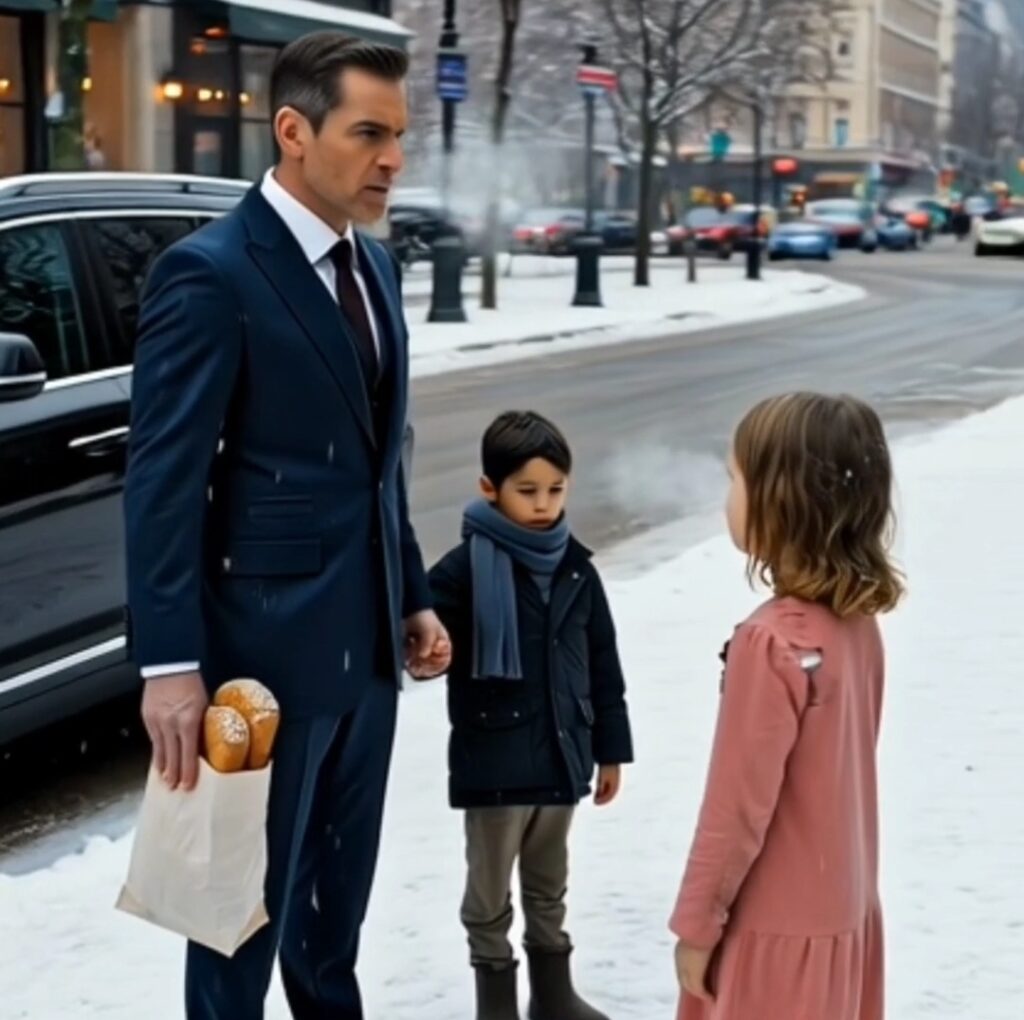
Adrian had everything money could buy. Towers downtown carried his company’s name. He wore tailored Italian suits and a watch that cost more than most of his employees’ cars. Yet every night, when he walked through the echoing halls of his mansion, he faced the one failure his fortune couldn’t fix: his son had never spoken.
Lucas was healthy. Perfect, doctors said. Bright hazel eyes, soft brown curls, a shy smile. But not a single word had ever crossed his lips. No cry at birth. No babbling. Not even “Dad.”
Adrian searched the world for answers. Specialists in Switzerland. Cutting-edge clinics in Boston. Alternative healers in remote mountains. The verdict never changed.
“Physically, he’s fine, Mr. Castillo. His vocal cords work. His brain is normal. There’s just… no connection. We can’t explain why he doesn’t speak.”
One icy morning, the city felt especially gray. Adrian stepped out of his black SUV in front of an upscale bakery downtown. The scent of warm butter and fresh brioche drifted into the cold air. He held Lucas in his arms, wrapped in a thick wool blanket. The boy clung to him, silent as always, eyes observing everything.
While his assistant went inside to collect their order, Adrian scrolled through emails, barely noticing the world around him.
Then someone tugged at his coat.
He looked down.
A little girl stood there, no older than eight. Barefoot on the freezing sidewalk. Her dress had once been pink; now it was torn and stained. Soot marked her hands and cheeks. In her hands, she held a crust of bread, hard and spotted with mold, as if it were treasure.
Adrian instinctively stepped back, shielding Lucas. “Go away,” he said coldly.
She didn’t move. She looked straight at him, then at Lucas. Something strange happened: Lucas reached toward her.
“Sir,” the girl said softly, “your son has many words trapped inside.”
Adrian’s heart jolted. “What?”
“He wants to speak. But he can’t. Because you don’t listen.”
Anger flared. “You have no idea what you’re talking about. Leave before I call security.”
She lifted the moldy bread slightly. “Give me your bread,” she said firmly. “Give me your bread, and I’ll make your son speak.”
Adrian let out a harsh laugh. “You think I’m an idiot? I don’t want tricks.”
“I don’t want your money,” she replied calmly. “I want your bread.”
At that moment, his assistant returned with a warm paper bag. The smell of sweet rolls filled the air.
Adrian was ready to get into the car and end the ridiculous scene. But Lucas suddenly squirmed in his arms, crying silently, reaching desperately toward the girl.
“Lucas, stop,” Adrian ordered.
But the boy wouldn’t calm down. Tears filled his eyes as he pointed at her again and again.
Adrian hesitated.
What do you have to lose? It’s just bread.
With irritation, he grabbed the bag and tossed it at the girl’s feet. “There. Take it.”
She bent down, picked it up carefully, and pulled out a warm roll. Adrian expected her to devour it instantly.
Instead, she broke it in half.
She ate one piece slowly. Then she stepped closer and held the other half toward Lucas.
“Don’t,” Adrian warned. “His hands—”
“It’s bread,” she said. “Bread is meant to be shared. If it isn’t shared, it doesn’t feed anyone.”
Lucas leaned forward and took it. He bit into the soft roll. Chewed. Swallowed.
The world seemed to pause.
The girl placed her hand gently over Lucas’s chest. “You’re not afraid,” she whispered. “Tell him.”
Adrian opened his mouth to protest.
Then he heard it.
At first, a rough sound. Then clearer.
“Da… ddy.”
Everything stopped.
“What did you say?” Adrian breathed.
Lucas smiled, glowing. “Daddy. Bread. Good.”
Adrian collapsed onto the pavement, suit and pride forgotten. He clutched his son and sobbed — five years of pain breaking loose at once.
When he finally looked up, the girl was gone. Only the crumpled paper bag fluttered in the wind.
That night, Lucas wouldn’t stop talking. He named colors. Asked for water. Said “Daddy” again and again just to hear himself.
Adrian was overwhelmed with joy — and confusion.
Why bread?
He searched for the girl obsessively. Hired investigators. Offered rewards. “Miracle Girl from Main Street.” No one could find her.
A month later, an elderly woman who sold flowers near the bakery called him.
“She didn’t use magic,” the woman said gently. “Your son carried your silence. Your pressure. Your control. You tried to fix him like a broken machine. The girl didn’t ask for money because that’s easy for you. She asked for bread — something simple. Something shared. When you let go of it, you let go of your pride. Your son felt that.”
The words pierced him.
For five years, he had treated Lucas like a project. A flaw to correct. He had never truly knelt, never simply been present without expectation.
That afternoon, Adrian made a radical decision.
He sold most of his shares. He purchased an abandoned building a few blocks from the bakery and transformed it into a warm, welcoming space with bright walls and a large kitchen that always smelled of fresh bread.
He named it “The Bread House.”
It became a refuge for homeless children — the invisible ones with tired eyes. Adrian spent his days there serving meals, listening to stories, sitting on the floor instead of behind a desk.
Lucas went with him after school. Every day, he made sure to split his roll in half before eating.
A year later, on the anniversary of the day everything changed, Adrian stood outside the shelter in the rain.
Across the street, he saw her.
The same girl. Thinner. Soaked.
He ran toward her and dropped to his knees. “Please. Come with me. You’ll never be hungry again.”
She smiled softly.
“You’ve already paid me back.”
“I only gave you bread.”
“I’m not talking about that.” She pointed at the glowing building filled with laughter. “You turned pain into love. Pride into service. That’s enough.”
Tears mixed with rain on Adrian’s face. “Tell me your name.”
She stepped backward into the shadows. “You can call me Hope.”
And she disappeared once more.
Adrian returned to the shelter, heart warm despite the storm. Lucas ran up to him.
“Daddy! Did you see her?”
Adrian picked up a roll and handed it to a new child sitting quietly at the table.
“Yes,” he said softly. “And I think she’s always been here.”
Because miracles don’t always come with thunder and light. Sometimes they arrive barefoot, asking for the one thing we guard most fiercely: our pride.
And when we finally open our hand, we realize we didn’t lose anything at all.
